The 8 HYROX stations in order, and how to survive each one
The eight HYROX stations always come in the same order: SkiErg, sled push, sled pull, burpee broad jumps, rowing, farmers carry, sandbag lunges, wall balls. A 1 km run comes before every one of them. The sequence is identical at every event worldwide — only the loads change by division.
The HYROX race format in one minute
A race is 8 km of running split into eight 1 km laps, with one station after each lap. You open with a run, not a station, and you finish with wall balls a few steps from the line. Transitions happen in the roxzone — the corridor between the run course and the station floor — and roxzone time counts toward your finish, which is why results break it out as its own split. For the full picture of waves, judging, and divisions, read what a HYROX race actually involves.
Divisions change the load, never the HYROX exercise order. Open, Pro, Doubles, and Relay all move through the same eight movements in the same sequence: Pro adds weight, Doubles splits the station work between two athletes, and Relay splits the whole race across four, each covering two runs and the two stations that follow them. Loads are published per division and have been revised between seasons, so check the current rulebook for the race you entered.
The 8 HYROX stations in order
| # | Station | Work | Open load (men / women) | Biggest time leak |
|---|---|---|---|---|
| 1 | SkiErg | 1,000 m | — | First 300 m too fast |
| 2 | Sled push | 50 m (4 × 12.5 m) | 152 kg / 102 kg incl. sled | Long rests at every turn |
| 3 | Sled pull | 50 m (4 × 12.5 m) | 103 kg / 78 kg incl. sled | Pulling with arms only |
| 4 | Burpee broad jumps | 80 m | bodyweight | Jumping too far, too early |
| 5 | Rowing | 1,000 m | — | Using it as a rest stop |
| 6 | Farmers carry | 200 m | 2 × 24 kg / 2 × 16 kg | The first set-down |
| 7 | Sandbag lunges | 100 m | 20 kg / 10 kg | Starting unbroken |
| 8 | Wall balls | 100 reps | 6 kg to 3 m / 4 kg to 2.7 m | No-reps on squat depth |
Pro keeps every distance and rep count and only moves the weight: 202 kg / 152 kg on the push, 153 kg / 103 kg on the pull, 2 × 32 kg / 2 × 24 kg on the carry, 30 kg / 20 kg on the bag, and a 9 kg / 6 kg ball. Doubles runs the Open loads, and mixed doubles uses the men's Open weights for both partners, with each athlete throwing to their own target height.
1. SkiErg, 1,000 m
You arrive fresh and that is the problem. The first 300 m feel free, and the receipt shows up two minutes later under the sled. Pull from the hips and lats with a full hinge rather than yanking with the arms, set the damper somewhere in the middle, and hold a pace you could repeat cold. The mistake that costs most: going 8–10 seconds per 500 m faster than honest pace, which buys 15–20 seconds and taxes the shoulders and triceps you need for the sled pull two stations later.
2. Sled push, 50 m
Four lengths of 12.5 m, and the most venue-dependent station in the sport — the same posted weight moves very differently on rubber, turf, or a polished sheet. Get low, arms locked out, hips down, short choppy steps, sled always moving; a stopped sled is far more expensive to restart than to keep rolling. The classic error is treating each 12.5 m length as a set and resting at the turn. Quads flood almost immediately and heart rate goes to the ceiling. That is normal here, not a sign you are blowing up.
3. Sled pull, 50 m
Also 4 × 12.5 m, performed from inside a marked box, rope hand over hand. Grip and lats are the currency, and both are already compromised from the SkiErg. Sit your weight back so the rope loads your hips and body weight instead of your biceps, and keep the slack managed — a rope piling into a tangle around your feet costs more time than a slow pull. The lap after the sled pull is the one people remember as the worst of the race, so plan for it to feel awful instead of panicking mid-lap.
4. Burpee broad jumps, 80 m
Chest and thighs to the floor, two-foot takeoff, two-foot landing, no extra steps between reps, 80 m of it. The winning approach is a metronome: modest jump distance, immediate turnover, no standing pause at the top. Big jumps cover ground fast for 20 m and leave you doubled over at 40 m, and stopped time here is unrecoverable. Stepping back into the plank instead of jumping back is legal, saves the legs, and costs almost nothing per rep.
5. Rowing, 1,000 m
The midpoint, and the only station where you get to sit down. Rowing is a real chance to bring heart rate off the ceiling, but that gets taken too literally — a lazy 1,000 m hands back half a minute or more for a recovery you never fully collect. Row slightly slower than your fresh 1 km pace, drive with the legs, keep the stroke rate low rather than thrashing. Everything after this is lower-body work under fatigue, so a hard row buys nothing and mortgages the last two stations.
6. Farmers carry, 200 m
Two kettlebells, 200 m, and grip that has already survived a rope and a ski handle. Some venues run it as one long out-and-back, others as several shorter laps, so listen to the briefing and count. You may set the bells down and pick them back up where you dropped them, but the first set-down is the expensive one — the second comes sooner, the third sooner still. Keep the shoulders packed and the ribs down, and walk with purpose rather than shuffling. Fast walkers who never break beat stronger athletes who break three times; if you must break, pick the spot in advance.
7. Sandbag lunges, 100 m
The bag rides across the shoulders behind the neck, and the trailing knee has to touch the ground on every rep. This is the station that decides most races. Legs are wrecked from two sleds and a row, the bag slides forward as you fatigue, and a slipped bag forces a reset. Take a shorter stride than feels natural — over-striding is what turns a lunge into a near-failure — and break the 100 m into planned segments rather than pushing to actual failure.
8. Wall balls, 100 reps
Hip crease below the top of the knee, ball to the target, judge watching every rep. The target sits at 3 m for men and 2.7 m for women in both Open and Pro. On dead legs at maximum heart rate, this is where no-reps happen — usually depth, sometimes a miss on the target. Pick your break pattern before you touch the ball and hold it: sets of 10 with five-second breaks beat a hero set of 30 followed by a spiral into singles. Breathe at the bottom of the catch and keep the throw path vertical.
Why the HYROX station order never changes
The fixed HYROX order of events is what makes the sport a race rather than a workout: a time in Hamburg means the same thing as a time in Dallas because the work was identical. Within that, the sequence is deliberate. Both sleds sit early, at stations 2 and 3, while you still have the leg strength to move them — put them after the lunges and the sled would decide the race instead of the athlete. Rowing lands at the midpoint as the one real reset. Grip-heavy work stacks late, and the two most no-rep-prone HYROX movements come last, on the most tired legs, in front of the crowd.
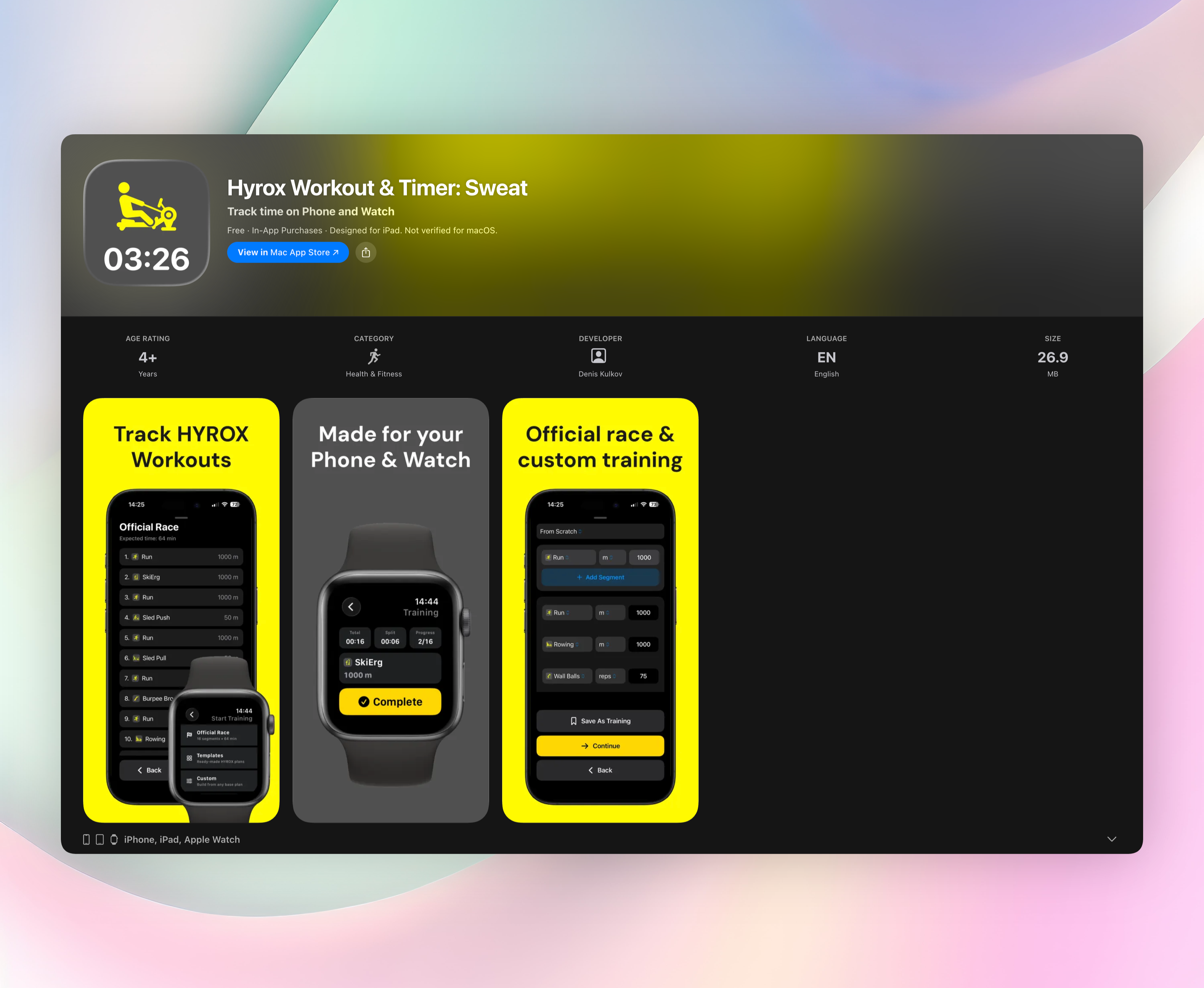
Because the sequence never varies, you can rehearse it exactly. Hyrox Workout, a HYROX workout timer app for iPhone and Apple Watch, holds the eight stations in race order so a simulation session runs straight through without you stopping to work out what comes next.
Train the order, not just the pieces. Athletes who only train HYROX exercises in isolation get caught out by how different wall balls feel after 7 km of running and 100 m of lunges.
FAQ
What are the 8 HYROX stations in order?
SkiErg 1,000 m, sled push 50 m, sled pull 50 m, burpee broad jumps 80 m, rowing 1,000 m, farmers carry 200 m, sandbag lunges 100 m, and 100 wall balls. A 1 km run comes before each station, so the race alternates run–station eight times.
Does the HYROX station order ever change?
No. The order, distances, and rep counts are the same at every event, which is what makes times comparable across cities. Only the loads differ — Pro is heavier than Open — and Doubles and Relay split the same work between athletes rather than reordering it.
Which HYROX station is the hardest?
Ask ten athletes and you get two answers: sandbag lunges or wall balls. The lunges land on legs already emptied by the sleds; wall balls punish technique breakdown with no-reps at the point you have least left. At venues with high-friction flooring, the sled push takes the title.
How much running is in a HYROX race?
8 km, as eight separate 1 km laps. Each lap is measured to 1 km, but layouts differ between venues and the roxzone adds walking that nobody counts, so a GPS watch indoors will rarely agree with the official distance.
Should I train the stations in race order?
Not every session. Train individual HYROX movements and running separately most of the week, then run full or half simulations in race order every few weeks so the compromised positions — lunging on ruined legs, gripping a bell with cooked forearms — stop being new.
Free Hyrox Workout tools
- 10K Pacing ChartUse this 10K pacing calculator to turn a target finish time or pace into kilometre-by-kilometre and mile-by-mile splits with cumulative times.
- 5K Pacing ChartEnter a target 5K finish time to see every kilometre or mile split, cumulative time and equivalent pace. This 5k pacing chart also includes common target times for quick reference.
- Concept2 Pace CalculatorUse any two of distance, total time and /500m split to find the missing value, watts, calories per hour and HYROX distance times.
- Half Marathon Pacing ChartCreate a half marathon pacing chart with cumulative 5 km and mile splits, plus the required pace for your target finish.
- HYROX Race Format PlannerChoose a HYROX category and team format to see the full race sequence, running distance, station work and sharing rules.
- HYROX Station Standards ReferenceUse this HYROX stations reference to review the eight stations in race order, with distances, reps and the standards that apply to your division.
- HYROX Finish Time CalculatorThis hyrox time calculator combines your average 1 km run pace, station time and roxzone transit time into a projected finish time and full race timeline.
- HYROX Training Program PlannerCreate a week-by-week HYROX plan with running, erg, strength, station-combination, recovery and simulation sessions.
- Interval Pacing TimerRun repeatable work and rest intervals with a large countdown, clear phase changes and optional audio cues. This pacing timer stays accurate when a tab is backgrounded.
- Marathon Pacing ChartBuild a marathon pacing chart from a target finish time or target pace. See required pace and cumulative times at every 5 km and every mile.
- Running Pace CalculatorUse this running pace calculator to turn a target finish time into clear per-kilometre and per-mile pacing, average speed and splits.
- Split Times CalculatorBuild a cumulative split table for any distance and interval. Compare even pacing with a fade or negative-split strategy and see the required pace for every segment.