HYROX rules: what judges actually enforce at every station
HYROX rules set one race format — eight 1 km runs alternating with eight stations — plus a movement standard for each station. Stations 1 to 7 give you one warning, then 15-second time penalties. Wall balls get no warnings: a rep either counts or it doesn't.
The HYROX format the rules are built around
Every race is the same shape: eight runs of roughly 1 km alternating with eight stations in a fixed order, ending in 100 wall balls. The designated running total is 8,000 m, split into whatever lap structure a venue's floor allows. For the wider picture, what a HYROX race involves covers the day, and the station order is worth memorizing first.
Singles has four divisions — Women, Women Pro, Men, Men Pro — and the HYROX format is identical across all of them. Only the loads change, and they overlap: Men's Open and Women's Pro both push a 152 kg sled and throw a 6 kg wall ball. Doubles, Pro Doubles and Relay run the same stations under separate rulebooks, and loads get revised between seasons, so read the current HYROX rulebook for your season.
How HYROX rules handle warnings, no-reps and penalties
There's no penalty box any more. Since the 2025/26 season every penalty is time, added to your result rather than served in a corner mid-race.
At stations 1 to 7 the sequence is fixed: the first infringement is a formal warning, the second invalidates the rep and costs 15 seconds, and each one after costs another 15, with no more warnings. Wall balls are different — no warnings at all, a rep or a no-rep, and you do it again.
The bigger numbers are about the course. A missed run lap costs 3 minutes on a four-lap course, 5 on a three-lap, 7 on a two-lap. Stations done out of order cost 3 minutes the first time and a DQ the second. Two minutes covers course errors: the wrong arch in or out of the Roxzone, outside assistance, littering, tipping aid-station water over your head. Some misses aren't penalties at all — skipping a run or station, leaving an erg or the wall balls early, missing a sled lane, or racing a station on the wrong weight and not redoing it are disqualifications.
HYROX standards, station by station
| Station | What the judge watches | Typical miss |
|---|---|---|
| 1,000 m SkiErg | Feet on the base plate; wait for the judge | A foot down on the floor |
| 50 m sled push | Whole sled past the 12.5 m mark before you turn | Turning early |
| 50 m sled pull | Inside the Racers Box, standing, off the line | A foot on the line mid-pull |
| 80 m burpee broad jump | Chest down; both feet take off and land together | A stagger wider than 5 cm |
| 1,000 m row | Seated until the judge confirms 1,000 m | Standing off the seat early |
| 200 m farmers carry | Both bells at arm's length, returned handles-up | Handles left tipped over |
| 100 m sandbag lunge | Knee touches, you stand tall, bag on the shoulders | A knee that hovers |
| 100 wall balls | Hips below knee level, ball strikes your target | Shallow squat or missed target |
HYROX burpee broad jump rules
This is where the standard slips as you tire. Four things get judged:
- Chest on the ground. The rulebook defines it as the nipple line making clear contact with the floor. No push-up, and no thigh contact required.
- Both feet take off and land together. Up to 5 cm of stagger between the front of one foot and the other is allowed; wider is an infringement. Extra steps or shuffles are never permitted.
- Hands within 30 cm of your toes. Your hands go down no more than 30 cm ahead of your front foot and can't move forward once they're down, and coming out of the burpee your feet can't travel past your fingertips.
- Both feet clear the line. Both feet fully cross the white line at the end of each section, and if a foot lands on the finish line you owe another rep.
You don't have to stand tall between reps, and you can put a knee down coming out of the bottom. Eighty meters is long enough that the HYROX burpee broad jump standard slips without you noticing — rehearse in 20 m blocks with your legs already cooked.
Sandbag lunges: knee contact and standing tall
One hundred meters of alternating walking lunges. The trailing knee must clearly touch the ground and every rep finishes standing tall, hips and knees extended — one penalty code covers both, at 15 seconds a time. No steps or shuffles between reps.
The bag stays supported on your shoulders: taking it off them is 15 seconds, and parking it on the ground, a barricade or your feet isn't a legal rest. Return it to the marked area at the end or that's 30 seconds more. Knee contact is where fatigue shows first, so practice where you can hear the knee land.
Run laps and Roxzone rules
You count your own laps. A venue lap screen is unofficial, and a missed lap is the most expensive mistake on the course. Anyone running 4:00/km or faster uses the Fast Lane on the inside; everyone else stays in the Running Lane.
The Roxzone is the transition between run and station, and time there is race time. In through the IN arch, out through the OUT arch — backwards is 2 minutes each time. Water comes from the aid stations; anything else you plan to eat has to be on you from the start — taking it from a friend is outside assistance.
HYROX equipment rules
The permitted list is closed. Knee sleeves, gloves (not grips), a weightlifting belt, wristbands, hydration packs and prescribed inhalers are allowed; anything else needs written permission from the Race Director, so lifting straps for the farmers carry are out. Whatever you do use, you carry from start to finish — handing it off is outside assistance.
Headphones, earplugs, phones, body cameras and camera- or audio-enabled smart glasses are forbidden. Closed-toe shoes everywhere except the wall ball rig, where you may take them off. Chalk is event-supplied only and only at the sled pull and farmers carry; your own chalk, or powdered chalk at the wall balls, costs 2 minutes each time. Your timing chip goes on your ankle — race without it and you're recorded as a did-not-start.
Rehearsing the standards at race tempo
Standards fail under pace. A rep you hold perfectly when rested is worth nothing if the chest contact disappears at kilometer six, so train them the way they get tested: 1 km run, straight into 80 m of burpees.
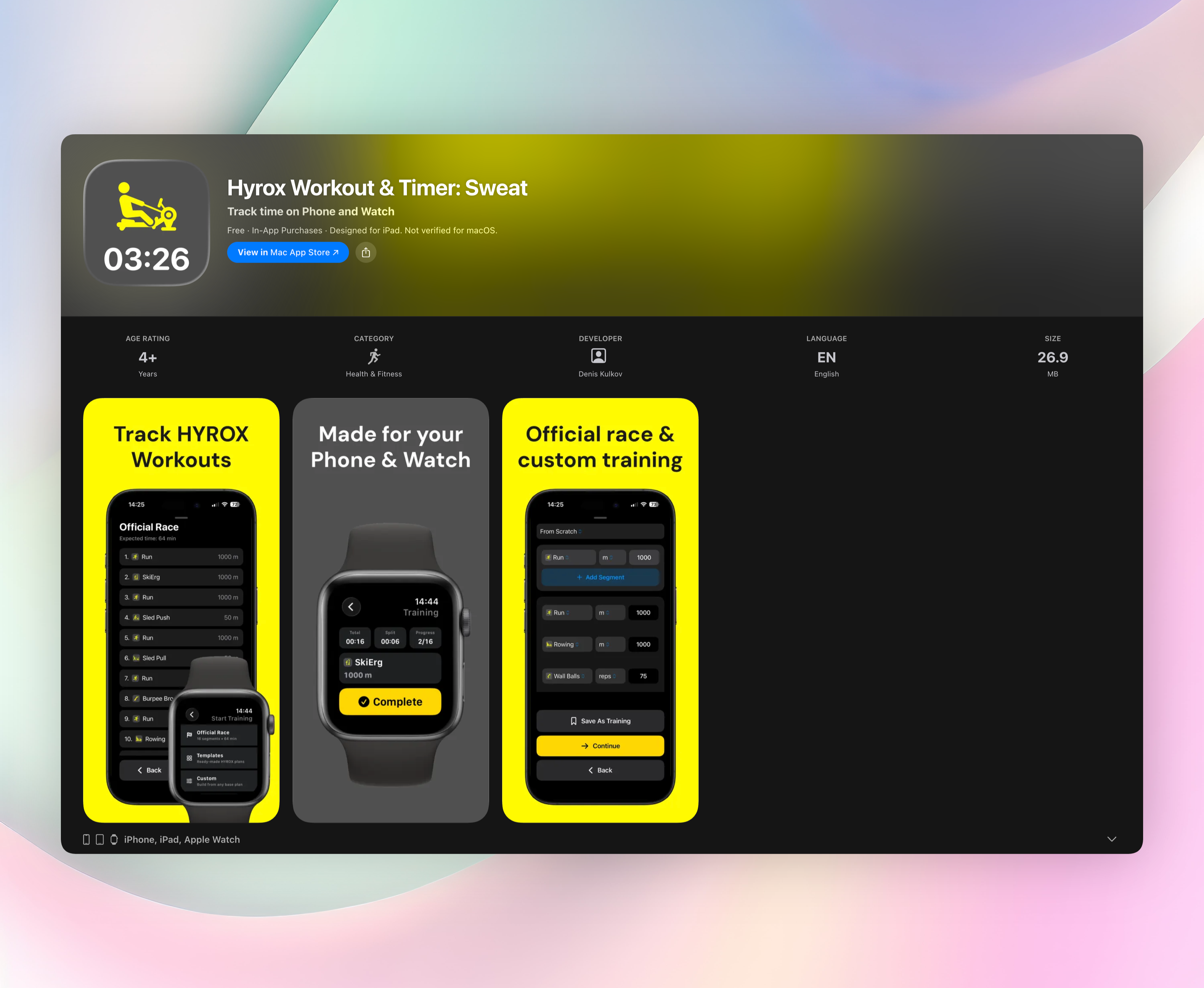
Running those practice reps against a station timer such as Hyrox Workout, a HYROX workout timer app for iPhone and Apple Watch, keeps you honest about pace instead of quietly slowing down to make the reps look clean.
FAQ
What counts as a no-rep in HYROX?
Any rep that misses the published standard — chest off the floor on a burpee, a trailing knee that never touches, hips above knee level or a missed wall ball target. At the wall balls it just doesn't count and you repeat it. Stations 1 to 7 give one warning, then 15 seconds each time.
Is there still a HYROX penalty box?
No. Penalties are time-based and added to your finish time rather than served during the race — a change introduced with the 2025/26 rulebook. Station infringements are mostly 15 or 30 seconds, course errors are 2 minutes, and a missed run lap is 3 to 7 minutes depending on the venue's lap structure.
Do HYROX rules differ between Open and Pro?
The movement standards are identical; only the weights change, and they overlap — Men's Open runs the same loads as Women's Pro. Wall ball target height is set by gender rather than division: 2.70 m for women, 3.00 m for men.
Can I wear gloves or use chalk during a HYROX race?
Gloves are permitted, grips are not. Chalk is tighter: event-supplied chalk only, at the sled pull and farmers carry, and never powdered chalk at the wall balls.
Where do I find the official HYROX rulebook?
HYROX publishes separate rulebooks for Singles, Doubles and Relay on its official site and reissues them each season, so the version matters. The athlete briefing adds venue detail like the lap structure and what a missed lap costs.
Free Hyrox Workout tools
- 10K Pacing ChartUse this 10K pacing calculator to turn a target finish time or pace into kilometre-by-kilometre and mile-by-mile splits with cumulative times.
- 5K Pacing ChartEnter a target 5K finish time to see every kilometre or mile split, cumulative time and equivalent pace. This 5k pacing chart also includes common target times for quick reference.
- Concept2 Pace CalculatorUse any two of distance, total time and /500m split to find the missing value, watts, calories per hour and HYROX distance times.
- Half Marathon Pacing ChartCreate a half marathon pacing chart with cumulative 5 km and mile splits, plus the required pace for your target finish.
- HYROX Race Format PlannerChoose a HYROX category and team format to see the full race sequence, running distance, station work and sharing rules.
- HYROX Station Standards ReferenceUse this HYROX stations reference to review the eight stations in race order, with distances, reps and the standards that apply to your division.
- HYROX Finish Time CalculatorThis hyrox time calculator combines your average 1 km run pace, station time and roxzone transit time into a projected finish time and full race timeline.
- HYROX Training Program PlannerCreate a week-by-week HYROX plan with running, erg, strength, station-combination, recovery and simulation sessions.
- Interval Pacing TimerRun repeatable work and rest intervals with a large countdown, clear phase changes and optional audio cues. This pacing timer stays accurate when a tab is backgrounded.
- Marathon Pacing ChartBuild a marathon pacing chart from a target finish time or target pace. See required pace and cumulative times at every 5 km and every mile.
- Running Pace CalculatorUse this running pace calculator to turn a target finish time into clear per-kilometre and per-mile pacing, average speed and splits.
- Split Times CalculatorBuild a cumulative split table for any distance and interval. Compare even pacing with a fade or negative-split strategy and see the required pace for every segment.