Average HYROX time, and what a good finish looks like
The average HYROX time is about 1:35 for open men and about 1:50 for open women, with most finishers landing between 1:20 and 2:10. Pro fields run faster because entry is filtered. Your own number comes down to 8 km of running and how badly the sleds hurt.
The average HYROX time, division by division
HYROX finish times cluster tighter than most endurance events, because everyone covers the same 8 km and the same eight stations, in the same order, at the same weights for their division. Typical bands from regular race weekends:
- Open men — the bulk of the field finishes between 1:20 and 1:50, with the middle sitting close to 1:35.
- Open women — most finish between 1:35 and 2:10, with the middle close to 1:50.
- Pro — less a separate curve than a filtered slice of the same one. HYROX points athletes toward pro once they're finishing open around 1:10 (men) or 1:25 (women), and pro fields sit near those marks. That guideline is enforced loosely, and how strictly varies by event and region.
Treat those as bands, not constants. HYROX publishes no official division averages, so every figure in circulation is somebody's read of the results — and a hot venue, a slick floor that eats sled times, or a tight run loop with a dozen turns per lap can shift an entire field by minutes. Comparing your Hamburg time to your Dallas time is not quite apples to apples.
Pro also flatters itself. The heavier pro weights genuinely cost time — men's sled push goes from 152 kg to 202 kg, the sandbag from 20 kg to 30 kg, the wall ball from 6 kg to 9 kg — but the athletes who choose pro are usually fast enough to absorb that penalty and still beat the open median.
What is a good HYROX time
The honest answer depends on which room you're comparing yourself to.
For a first-timer with a running background, anything under two hours is a solid day out. Break 1:30 in open men or 1:45 in open women and you're in the front half of most fields. The top 10% of an open men's field is generally going under about 1:15, and the top 10% of an open women's field under about 1:25, though the exact cutoff moves with the size and depth of the event.
What separates mid-pack from top 10% is rarely one heroic station. It's a runner who can still hold 6:30/km on leg eight, sled times that don't triple under fatigue, and a transition habit that doesn't quietly leak three or four minutes.
HYROX average time by age group
The HYROX average time by age curve is flatter than most people expect, because pacing discipline and raw strength offset part of the aerobic decline. The late-20s and 30s bands hold the quickest medians. Through the early 40s the cost is small, a handful of minutes. From the mid-40s it steepens — figure something like five to ten minutes off a 25–29 baseline by 45–49, and fifteen or more past 55. The decline usually shows up in the running blocks before it shows up at the stations.
Two practical implications. Compare yourself inside your own band rather than against the overall field: a 1:35 at 52 is a very different performance from a 1:35 at 27. And age-group placings are where most amateurs actually race — the overall leaderboard is a different sport.
Where the HYROX world record sits
As of the 2025/26 season, the men's pro record is 51:59, set by Alexander Rončević at the Warsaw Major in April 2026, the first sub-52 in the sport. The women's pro record is 54:25, by Joanna Wietrzyk at the same event. Both marks are division-specific and both have moved more than once in recent seasons, so treat any figure you read as a snapshot and check the current official results.
One quirk worth knowing: on the men's side the open record is faster than the pro record. Lighter open weights make the course quicker, so the fastest men's HYROX finish times on the books were set in open, not pro.
Useful context for the rest of us. A sub-52 race means running 8 km at close to 3:45/km and clearing all eight stations in under 20 minutes, with under four minutes lost in transition. That's not a scaled-up version of a 1:30 race. It's a different pacing model.
Splitting a goal time: running, stations, and roxzone
This is the part that turns a target into a plan. Every HYROX finish is three numbers, not one:
- Running — 8 × 1 km. For a 1:30 finish, budget 54:00, an average of 6:45/km.
- Stations — the eight workouts. Budget 30:00.
- Roxzone — the transition clock, run lane to station and back again. Budget 6:00.
Roxzone is the cheapest time on the course and the one nobody trains. Athletes finishing under 1:10 tend to clear the whole race's transitions in under four minutes, around 30 seconds apiece; a 1:30-plus finisher is often nearer seven, in increments of walking, chalking, and adjusting a belt. Closing most of that gap requires no fitness at all.
Here's how a sub-1:30 open plan compares to a typical mid-pack day, roughly a 1:50 finish:
| Station | Typical mid-pack | Sub-1:30 target |
|---|---|---|
| SkiErg 1000 m | 4:45 | 4:15 |
| Sled push 50 m | 4:00 | 2:30 |
| Sled pull 50 m | 5:00 | 3:00 |
| Burpee broad jumps 80 m | 6:30 | 4:30 |
| Row 1000 m | 4:45 | 4:15 |
| Farmers carry 200 m | 2:15 | 1:45 |
| Sandbag lunges 100 m | 6:00 | 4:45 |
| Wall balls ×100 | 8:00 | 5:00 |
| Station total | 41:15 | 30:00 |
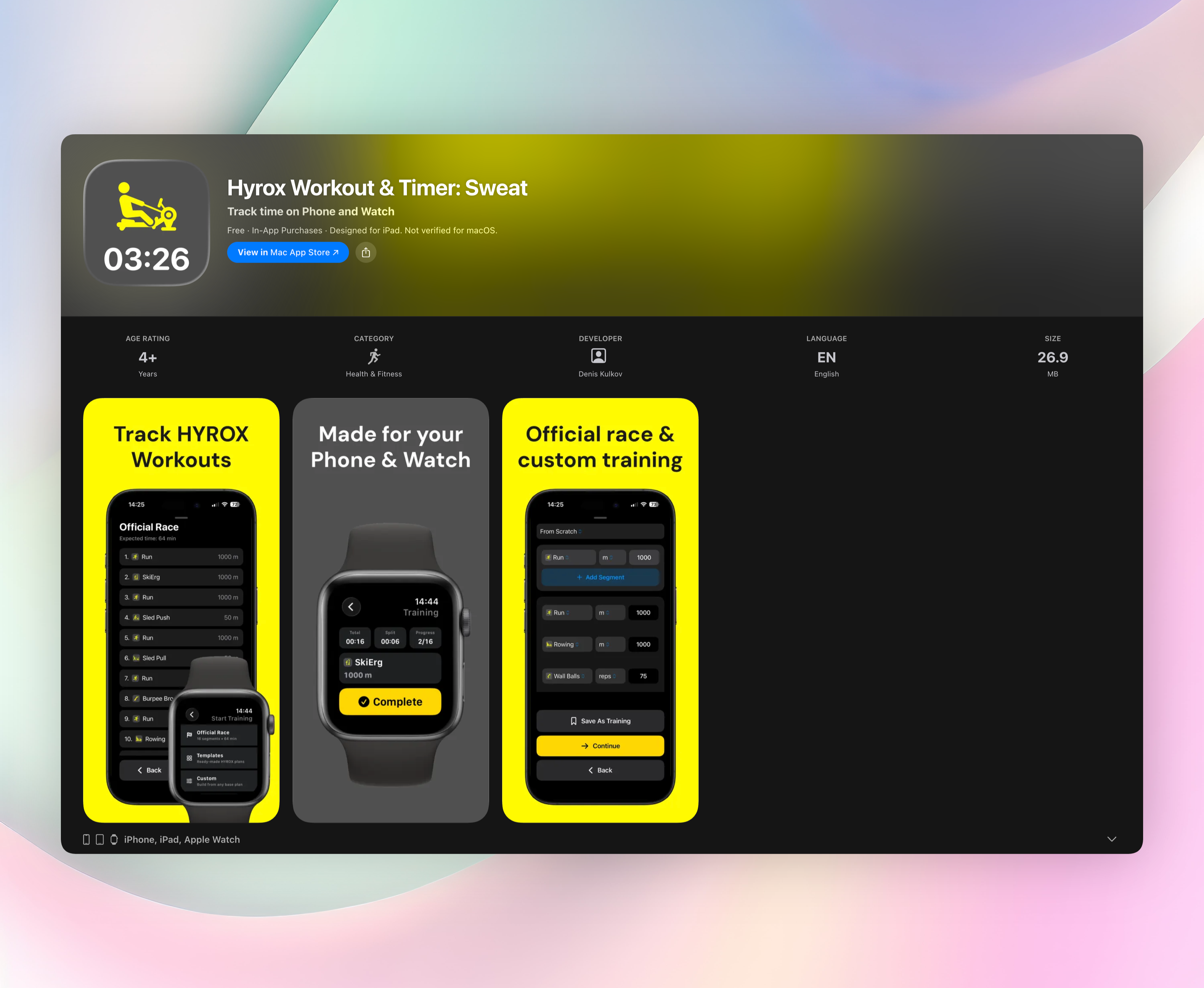
Numbers like these only help if you can see them while your heart rate is at 180. Hyrox Workout is a HYROX workout timer app for iPhone and Apple Watch — the per-station targets sit on your wrist and count down as you work, so the plan survives contact with the race.
Which HYROX split times to attack first
Compare your own splits against the table above and the gaps tend to be obvious. The two sleds and the wall balls usually account for the largest blocks of lost time in an open field, and all three respond quickly to specific practice — sled work on the surface you'll actually race on, and wall ball sets broken deliberately (25-15-10, or 20-20-10-10) instead of going to failure at rep 34 and paying for it for four minutes.
Running is the slower fix but the bigger one. Eight kilometers is more than half of a 1:30 race, so twenty seconds per kilometer is nearly three minutes of finish time. The specific skill is running on legs that have just done 100 wall balls, which is why compromised-running sessions beat fresh-legs intervals here.
Roxzone comes free. Know the floor plan, move with purpose, stop re-tying your shoes.
FAQ
What is the average HYROX time for a first-timer?
First-timers in the open division usually land between 1:30 and 1:55 for men, and between 1:45 and 2:10 for women. Athletes with a running background often beat that. Those coming from pure strength training get caught out on leg six or seven, when the running blocks start costing far more than the stations do.
Is a 90-minute HYROX time good?
For open men, 1:30 sits just ahead of the middle of the field — a respectable result and a common first target. For open women, 1:30 is a strong time that lands well inside the front quarter of most fields.
How much slower is pro than open?
Nobody publishes a clean same-athlete comparison, but the arithmetic is easy to follow. The runs, SkiErg, row, and burpee broad jumps are identical across divisions. Everything else gets heavier — for men, 50 kg more on each sled, 8 kg more per farmers-carry handle, 10 kg more on the sandbag, 3 kg more on the wall ball — so the whole penalty falls on five stations and shows up as minutes, not a different race.
How much time is lost in the roxzone?
Transition time runs from under four minutes for the fastest athletes to around seven for a 1:30-plus finisher, spread across the eight transitions. Per crossing that's roughly 30 seconds versus 50. It's the only part of the race you can improve without getting fitter.
What's the fastest HYROX time ever recorded?
The men's pro record stands at 51:59 and the women's pro record at 54:25, both set at the Warsaw Major in April 2026. Faster men's times exist in the open division, where the weights are lighter. Records have fallen most seasons, so check the season's official results rather than any article.
Free Hyrox Workout tools
- 10K Pacing ChartUse this 10K pacing calculator to turn a target finish time or pace into kilometre-by-kilometre and mile-by-mile splits with cumulative times.
- 5K Pacing ChartEnter a target 5K finish time to see every kilometre or mile split, cumulative time and equivalent pace. This 5k pacing chart also includes common target times for quick reference.
- Concept2 Pace CalculatorUse any two of distance, total time and /500m split to find the missing value, watts, calories per hour and HYROX distance times.
- Half Marathon Pacing ChartCreate a half marathon pacing chart with cumulative 5 km and mile splits, plus the required pace for your target finish.
- HYROX Race Format PlannerChoose a HYROX category and team format to see the full race sequence, running distance, station work and sharing rules.
- HYROX Station Standards ReferenceUse this HYROX stations reference to review the eight stations in race order, with distances, reps and the standards that apply to your division.
- HYROX Finish Time CalculatorThis hyrox time calculator combines your average 1 km run pace, station time and roxzone transit time into a projected finish time and full race timeline.
- HYROX Training Program PlannerCreate a week-by-week HYROX plan with running, erg, strength, station-combination, recovery and simulation sessions.
- Interval Pacing TimerRun repeatable work and rest intervals with a large countdown, clear phase changes and optional audio cues. This pacing timer stays accurate when a tab is backgrounded.
- Marathon Pacing ChartBuild a marathon pacing chart from a target finish time or target pace. See required pace and cumulative times at every 5 km and every mile.
- Running Pace CalculatorUse this running pace calculator to turn a target finish time into clear per-kilometre and per-mile pacing, average speed and splits.
- Split Times CalculatorBuild a cumulative split table for any distance and interval. Compare even pacing with a fade or negative-split strategy and see the required pace for every segment.