Hyrox doubles and relay explained: rules, weights, and splits
In Hyrox doubles, two partners run all 8 km together and share the eight stations, one working while the other rests. In relay, four athletes split the same race — each covers 2 km of running and two stations, tagging in the Transition Zone. Same course, different race.
How Hyrox doubles works
The course is the individual course: eight 1 km runs alternating with the eight standard stations, SkiErg first, wall balls last. Both partners cover the full 8 km, and the rulebook is blunt about it — if one runs ahead the team takes a 1-minute penalty, and more than three of those leaves the team out of competition with no ranking. You enter and leave every station together.
The work is what gets shared. A 1,000 m row is 1,000 m for the team; 100 wall balls is 100 for the team. One partner works at a time on every station — the format's own name for it is You Go I Go — and the resting partner stays on their feet inside the marked zone. If the course is new to you, the race walkthrough covers the order first.
Hyrox doubles rules station by station
Switches are unlimited and self-selected; what changes is how the handover may happen.
- SkiErg and row, 1,000 m each — the monitor keeps counting, so never reset it. You can't pass the handle to each other or adjust your partner's damper.
- Sled push and sled pull, 50 m each — four 12.5 m lengths, and the sled must fully cross the line before turning, so lane ends are the natural switching point. The resting partner walks behind, never alongside, and can't touch the rope.
- Burpee broad jumps, 80 m — the incoming partner puts their hands where the outgoing partner's feet landed, fingers and toes in line.
- Farmers carry, 200 m — one pair of kettlebells for the team, passed sideways or backward, never forward. You may set them down to rest as long as they don't travel forward.
- Sandbag lunges, 100 m — same never-forward rule, and the bag stays on a shoulder: putting it down costs 15 seconds each time. Trailing knee to the floor, tall at the top.
- Wall balls, 100 reps for the team — hand the ball over or let it hit the floor. A flying transition, one partner throwing and the other catching in the squat, is a no-rep.
Hyrox mixed doubles weights
Mixed doubles lifts the men's Open loads on everything: sled push 152 kg including the sled, sled pull 103 kg including the sled, 2 x 24 kg kettlebells, a 20 kg sandbag and a 6 kg wall ball. Only the wall ball target stays personal — 3.00 m for the male partner, 2.70 m for the female partner, same ball.
Women's doubles is the lighter column throughout: 102 kg push, 78 kg pull, 2 x 16 kg carry, 10 kg bag, 4 kg ball. A woman racing mixed therefore trains everything above her own division, and mixed teams underestimate that constantly. Loads get revised between seasons, so check the weight table for your season.
How the Hyrox relay format works
The Hyrox relay format is four athletes, each running 2 x 1 km and completing two stations. A team is four women, four men, or two of each, and there is no Pro relay. Who takes which station is the team's call — the rulebook assigns nothing. The common split runs straight through the course:
- Racer 1 — run, SkiErg, run, sled push
- Racer 2 — run, sled pull, run, burpee broad jumps
- Racer 3 — run, row, run, farmers carry
- Racer 4 — run, sandbag lunges, run, wall balls
Handovers happen in the Transition Zone, with a high five; the next racer steps in shortly before the exchange, no loitering. A racer going back to back still has to pass through the zone after each station so the chip is read.
Weights are per athlete: everyone uses their own division's loads, so a mixed relay never puts anyone on someone else's sled. That is the clearest practical difference from mixed doubles.
Seed the team accordingly. Racer 1 wants a strong pusher; racers 2 and 3 carry the grip work; racer 4 gets lunges then wall balls on legs that have already run 2 km, so give that slot to whoever holds form when tired. Once those wall balls start the other three are let in under the rig to finish together.
Doubles or relay for a first race
| Doubles | Relay | |
|---|---|---|
| Team size | 2 | 4 |
| Running per athlete | 8 km | 2 km |
| Stations per athlete | about half of all eight | 2 |
| Mixed-team weights | men's Open on everything | each athlete's own |
| Pro division | yes | no |
Relay is the softer entry and the only version that absorbs a big fitness gap between teammates.
Splitting the work so it holds up
Matched partners default to even blocks: 250 m each on the ergs, alternate lengths on both sleds, a swap every five to eight burpee broad jumps, the bag changing hands at each turnaround, 25 wall balls each. Even blocks keep both heart rates in the same place, and you leave every station running.
Mismatched partners should stop splitting evenly. The pair runs at the slower runner's pace, so the stronger runner arrives at every station with capacity to spare — give them the extra work: three of the four erg blocks, both extra sled lengths, a 30/20 wall ball split.
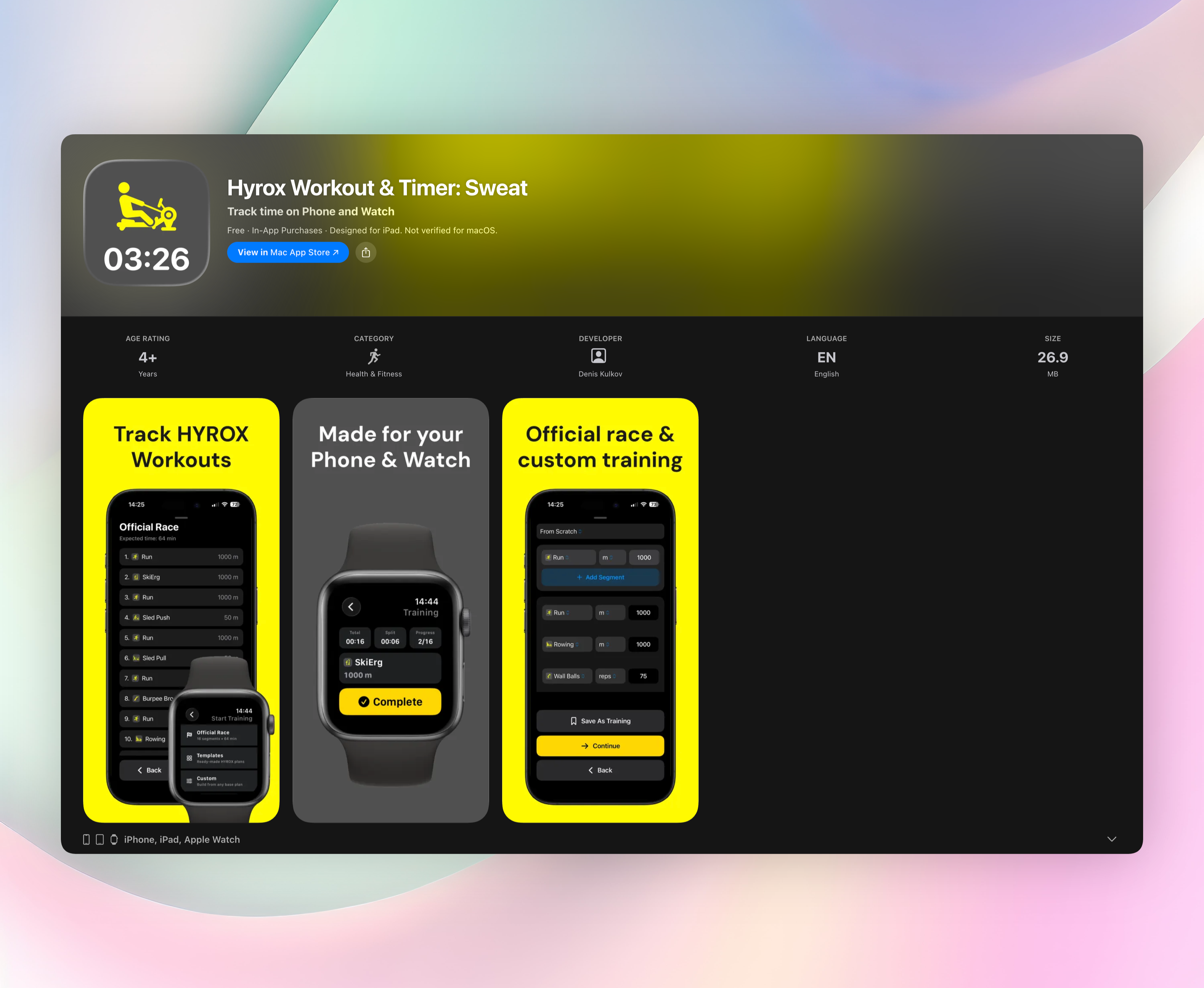
Agree it all before race day and rehearse it once. Timing a doubles rehearsal with Hyrox Workout, a HYROX workout timer app for iPhone and Apple Watch, shows which partner is genuinely faster on each station instead of guessing from how training feels.
Swaps that get teams penalized
Judges watch the handover more than the reps. The usual calls: passing the sandbag or kettlebells forward, the resting partner walking alongside instead of behind or dropping to a knee, flying wall ball transitions, and on the run, one partner drifting ahead at a minute a time. Relay teams get caught loitering in the Transition Zone or tagging outside it. Read the movement standards with your partner, not alone — half of these errors are one person's misunderstanding.
FAQ
How does Hyrox doubles work?
Two athletes run all eight 1 km legs together and share every station, one working while the other rests. Station volumes match an individual race — 1,000 m on each erg, 100 wall balls, 200 m of farmers carry — so each partner does roughly half.
Do both partners have to run every kilometer?
Yes. The running is the one part of Hyrox doubles rules with no split. Both cover the full 8 km side by side, and a partner who runs ahead earns the team a 1-minute penalty; more than three of those and the team loses its ranking.
What weights do mixed doubles teams use?
Men's Open across the board: 152 kg sled push and 103 kg sled pull, both including the sled, plus 2 x 24 kg kettlebells, a 20 kg sandbag and a 6 kg wall ball. The one per-athlete difference is the wall ball target: 3.00 m for men, 2.70 m for women. Loads change between seasons — confirm your event's table.
Is a Hyrox relay easier than doubles?
Per athlete, yes: 2 km of running and two stations instead of 8 km and half a race, and everyone lifts their own division's weights. The trade-off is that your two stations arrive with no partner to hand them to.
Free Hyrox Workout tools
- 10K Pacing ChartUse this 10K pacing calculator to turn a target finish time or pace into kilometre-by-kilometre and mile-by-mile splits with cumulative times.
- 5K Pacing ChartEnter a target 5K finish time to see every kilometre or mile split, cumulative time and equivalent pace. This 5k pacing chart also includes common target times for quick reference.
- Concept2 Pace CalculatorUse any two of distance, total time and /500m split to find the missing value, watts, calories per hour and HYROX distance times.
- Half Marathon Pacing ChartCreate a half marathon pacing chart with cumulative 5 km and mile splits, plus the required pace for your target finish.
- HYROX Race Format PlannerChoose a HYROX category and team format to see the full race sequence, running distance, station work and sharing rules.
- HYROX Station Standards ReferenceUse this HYROX stations reference to review the eight stations in race order, with distances, reps and the standards that apply to your division.
- HYROX Finish Time CalculatorThis hyrox time calculator combines your average 1 km run pace, station time and roxzone transit time into a projected finish time and full race timeline.
- HYROX Training Program PlannerCreate a week-by-week HYROX plan with running, erg, strength, station-combination, recovery and simulation sessions.
- Interval Pacing TimerRun repeatable work and rest intervals with a large countdown, clear phase changes and optional audio cues. This pacing timer stays accurate when a tab is backgrounded.
- Marathon Pacing ChartBuild a marathon pacing chart from a target finish time or target pace. See required pace and cumulative times at every 5 km and every mile.
- Running Pace CalculatorUse this running pace calculator to turn a target finish time into clear per-kilometre and per-mile pacing, average speed and splits.
- Split Times CalculatorBuild a cumulative split table for any distance and interval. Compare even pacing with a fade or negative-split strategy and see the required pace for every segment.