Hyrox running distance: how far you run, and how fast
The Hyrox running distance is 8 kilometers: eight 1 km laps, one before every station, which works out to just under 5 miles. The Roxzone transitions add a few hundred meters on top. Open, Pro, and Doubles all cover the same 8 km.
The Hyrox running distance, lap by lap
Hyrox opens with a run and alternates from there: 1 km, station, 1 km, station, eight times through. There is no finishing lap — the race ends on wall balls.
- Run 1 → 1000 m SkiErg
- Run 2 → 50 m Sled Push
- Run 3 → 50 m Sled Pull
- Run 4 → 80 m Burpee Broad Jumps
- Run 5 → 1000 m Row
- Run 6 → 200 m Farmers Carry
- Run 7 → 100 m Sandbag Lunges
- Run 8 → Wall Balls, 100 reps
Eight kilometers is 4.97 miles, so if someone asks how far you run in Hyrox, "just under five miles" is close enough, while 8 km is the number on the results sheet. Weights and rep standards change between Open and Pro; the distances never do. For what each station demands, the station order breakdown covers it.
The lap is rarely a straight kilometer. Courses are built inside an exhibition hall, so 1 km is usually several circuits of a shorter loop with tight 180-degree turnarounds. Those turns cost real time — you decelerate and re-accelerate over and over, on legs that are already unhappy.
Does the Roxzone count toward the Hyrox run distance?
No. The Roxzone is the transition area between the run track and the station floor, and the ground you cover crossing it is not part of the measured 8 km. You cross it after every run and again after every station, which at a large venue adds a few hundred meters across the race.
Roxzone time shows up as its own split in your results. It is the cheapest time in the race to lose and the cheapest to win back: sharp athletes jog the transitions and set up fast, while first-timers walk and hand back minutes without noticing. So the honest answer to how much running Hyrox involves is 8 km measured, plus whatever the Roxzone adds.
Compromised running: why your race pace drops
Compromised running is running on legs and lungs already wrecked by the station you just left. It is the defining skill of the sport, and the reason a Hyrox 8 km looks nothing like a road 8 km.
Each station leaves a different kind of damage:
- Sled push (before Run 3) torches quads and calves. This is where most first-timers find their legs stop obeying.
- Sled pull (before Run 4) loads the posterior chain and grip, and the stop-start pulling pattern keeps heart rate pinned.
- Burpee broad jumps (before Run 5) spike heart rate harder than anything else on the floor.
- Sandbag lunges (before Run 8) are the cruelest placement in the race — quads gone, one kilometer left before wall balls.
Expect your average lap to land roughly 30 to 90 seconds per kilometer slower than a fresh 8 km, and the gap widens if your strength work lags your running.
Hyrox running pace targets by finish time
Running is roughly half the total race clock for most finishers; stations and Roxzone take the rest. These bands assume even-ish splits and a Roxzone you are not donating time to, and they move with the venue and your station speed.
| Target finish | Avg lap pace (per km) | Avg lap pace (per mile) | Total run time |
|---|---|---|---|
| 1:00:00 | 3:50–4:05 | 6:10–6:35 | ~32 min |
| 1:15:00 | 4:35–4:50 | 7:20–7:45 | ~38 min |
| 1:30:00 | 5:25–5:45 | 8:45–9:15 | ~45 min |
| 1:45:00 | 6:15–6:40 | 10:05–10:45 | ~52 min |
| 2:00:00 | 7:00–7:30 | 11:15–12:05 | ~58 min |
Reality never looks that even. Lap 1 is almost always the fastest, and laps 3, 4, and 8 the slowest. A useful rule: cap Lap 1 at your target average and let laps 3 and 4 be slow on purpose. For where these targets sit in a real field, see average Hyrox finish times.
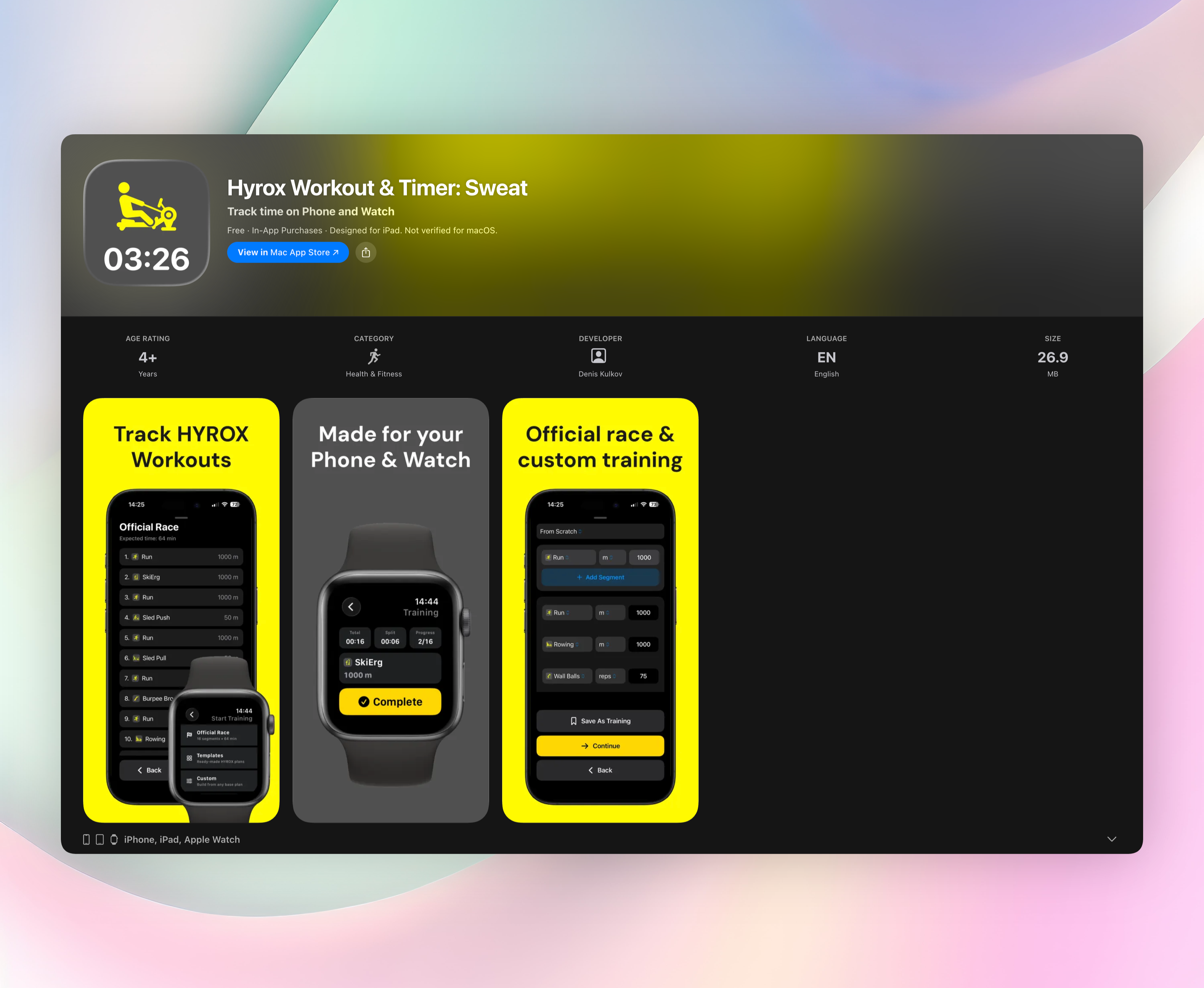
Holding a band in training means timing the run and the station as one block, not glancing at a wall clock between efforts. Hyrox Workout is a HYROX workout timer app for iPhone and Apple Watch, so a run-station-run set gets timed as one piece.
How to train for compromised legs
Training the two halves separately does not build this. The sessions that work put a station immediately before a run, every time.
Run-station-run intervals. 1 km at goal lap pace, one station at race weight, then 1 km again, four to six rounds. Your second kilometer will be embarrassing at first, which is the point.
Sled and lunge rehearsals. Sleds are the widest gap between gym fitness and race fitness, because almost nobody trains heavy pushes on race-style flooring. Push 50 m at race weight, then run 400 m immediately. Do the same with 100 m of sandbag lunges into 1 km at goal pace, and Run 8 stops being a surprise.
Aerobic base underneath it. Fatigued pace is capped by fresh pace. If your standalone 5 km sits at 25 minutes, no amount of interval work produces race laps at 5:30/km. Keep two easy runs and one threshold session alongside the hybrid work.
FAQ
How many miles is Hyrox?
The measured run distance is 8 kilometers — 4.97 miles — in eight 1 km laps. Roxzone transitions add a few hundred meters that never appear on the results sheet.
Do you still run 8 km in Hyrox doubles?
Yes. In Doubles both partners run all eight kilometers together and divide the station work between them. Relay is the exception: four athletes each cover two runs and two stations, so 2 km apiece. The doubles and relay guide explains the splits.
Is the Hyrox run on a track or a treadmill?
Neither. It is a marked course on the floor of an indoor venue, usually a loop covered several times per kilometer with tight turnarounds. Treadmills are not part of the standard race format.
Why is my Hyrox running pace so much slower than my road pace?
Because every lap starts on pre-fatigued legs and heart rate never fully resets. A 30 to 90 second per kilometer drop from fresh 8 km pace is normal, and larger for athletes whose strength work lags their running.
Which run is the hardest?
Run 3, off the sled push, and Run 8, off the sandbag lunges. Both follow a station that hammers the quads, and Run 8 arrives with nothing left to spend.
Free Hyrox Workout tools
- 10K Pacing ChartUse this 10K pacing calculator to turn a target finish time or pace into kilometre-by-kilometre and mile-by-mile splits with cumulative times.
- 5K Pacing ChartEnter a target 5K finish time to see every kilometre or mile split, cumulative time and equivalent pace. This 5k pacing chart also includes common target times for quick reference.
- Concept2 Pace CalculatorUse any two of distance, total time and /500m split to find the missing value, watts, calories per hour and HYROX distance times.
- Half Marathon Pacing ChartCreate a half marathon pacing chart with cumulative 5 km and mile splits, plus the required pace for your target finish.
- HYROX Race Format PlannerChoose a HYROX category and team format to see the full race sequence, running distance, station work and sharing rules.
- HYROX Station Standards ReferenceUse this HYROX stations reference to review the eight stations in race order, with distances, reps and the standards that apply to your division.
- HYROX Finish Time CalculatorThis hyrox time calculator combines your average 1 km run pace, station time and roxzone transit time into a projected finish time and full race timeline.
- HYROX Training Program PlannerCreate a week-by-week HYROX plan with running, erg, strength, station-combination, recovery and simulation sessions.
- Interval Pacing TimerRun repeatable work and rest intervals with a large countdown, clear phase changes and optional audio cues. This pacing timer stays accurate when a tab is backgrounded.
- Marathon Pacing ChartBuild a marathon pacing chart from a target finish time or target pace. See required pace and cumulative times at every 5 km and every mile.
- Running Pace CalculatorUse this running pace calculator to turn a target finish time into clear per-kilometre and per-mile pacing, average speed and splits.
- Split Times CalculatorBuild a cumulative split table for any distance and interval. Compare even pacing with a fade or negative-split strategy and see the required pace for every segment.