
What is a hybrid athlete — and what hybrid training costs you
A hybrid athlete trains endurance and strength concurrently instead of periodizing them into separate blocks. The goal isn't to be great at one and passable at the other — it's to hold both at once, year-round. That concurrency is the whole discipline, and it's also the whole problem.
What is a hybrid athlete in practice
There's no governing body and no number that makes you one. The useful test is structural: in a single week, are you doing endurance work a runner would recognize as real training and strength work a lifter would recognize as real training? If yes, you're hybrid. If you run all spring and lift all winter, you're periodized — a legitimate approach, just a different one.
The distinction changes what you're allowed to expect. A sequential athlete chases one adaptation at a time with a clean recovery budget. A hybrid athlete splits that budget every week, and both sides notice. Rough shapes, not prescriptions:
| Pure endurance | Pure strength | Hybrid | |
|---|---|---|---|
| Weekly running | High, often 60km+ | Little to none | Moderate, roughly half a runner's |
| Weekly lifting | Optional, brief | 4–6 sessions | 2–3 sessions |
| Main limiter | Aerobic ceiling | Tissue and neural recovery | Total recovery budget |
| What's sacrificed | Absolute strength | Aerobic base | Peak in either |
| Benchmark event | Marathon, 10k | Meet total | HYROX and other hybrid races |
The interference effect is the real constraint
Run hard and lift heavy in the same week and the strength side pays first. That's the interference effect: concurrent endurance work blunts strength and hypertrophy adaptation compared with lifting alone. It's asymmetric — endurance work interferes with strength more than lifting interferes with running — and it lands hardest on the lower body, because that's where the running volume goes.
Two things drive it. The smaller one is molecular: the signaling pathways switched on by long aerobic work and by heavy resistance work pull in different directions. The bigger one is boring. Legs that ran 16km on Tuesday don't squat well on Wednesday, and a session that grinds badly produces little adaptation for the damage it causes.
The practical levers, in order of usefulness:
- Proximity. Don't stack a hard run and a heavy lower-body lift inside the same few hours. Separate them by a day where the calendar allows, by six hours or more where it doesn't.
- Modality. Cycling, rowing, and skiing cost your legs far less eccentric damage than running. A lot of HYROX conditioning volume belongs on low-impact machines for exactly this reason.
- Volume. Interference scales with endurance volume. At modest mileage most people add strength without much conflict; push the running up and something has to give.
- Order. If a session must combine both, put the quality you're prioritizing first, while you're fresh.
Why HYROX became the hybrid athlete's benchmark
HYROX is a fixed-format indoor race: eight 1km runs alternating with eight workout stations, 8km of running in total, identical for everyone on the floor. The station order never changes — SkiErg, sled push, sled pull, burpee broad jumps, row, farmers carry, sandbag lunges, wall balls — and the clock keeps running through the transition area, the roxzone, so moving between the run lane and the station is part of the event.
That structure is what makes it a hybrid test rather than a running race with obstacles. A fast 10k runner still gets stopped dead by a loaded sled. A strong lifter who moves that sled easily discovers that 8km of running, broken into eight pieces and run on legs that just finished 100 meters of sandbag lunges, exposes a missing HYROX engine faster than anything else will. Loads scale by division and sex, and the station weights are worth knowing before you write a plan around them. If the format is new to you, the full race walkthrough covers the rules and standards.
Building a hybrid athlete training week
Six sessions, one real rest day, and one session that neither a runner's plan nor a lifter's plan will hand you.
- Monday — heavy lower body. Squat or deadlift as the main lift, 3–5 sets in the 3–5 rep range, plus a hinge or single-leg accessory. This is a strength day; treat it like one.
- Tuesday — easy aerobic run. 45–60 minutes at a conversational pace. Easy means easy. Most people run this too hard, then wonder why Wednesday hurts.
- Wednesday — compromised running. Alternate 1km runs at race effort with a station: sled push, wall balls, burpee broad jumps, farmers carry. Four to six rounds. This teaches your legs to run once they've been loaded, and it's the highest-return session in HYROX hybrid training.
- Thursday — upper body and pulling. Press, row, pull-up, plus grip and trunk work. Deliberately low leg cost, so Friday's run isn't compromised.
- Friday — quality run. Threshold work or 1km repeats near race pace. Fresh legs, real intensity.
- Saturday — rest. Actually rest.
- Sunday — long easy aerobic. 75–100 minutes. Run it, or split it onto a bike or rower if your legs are beaten up. This is the piece most people cut first and shouldn't.
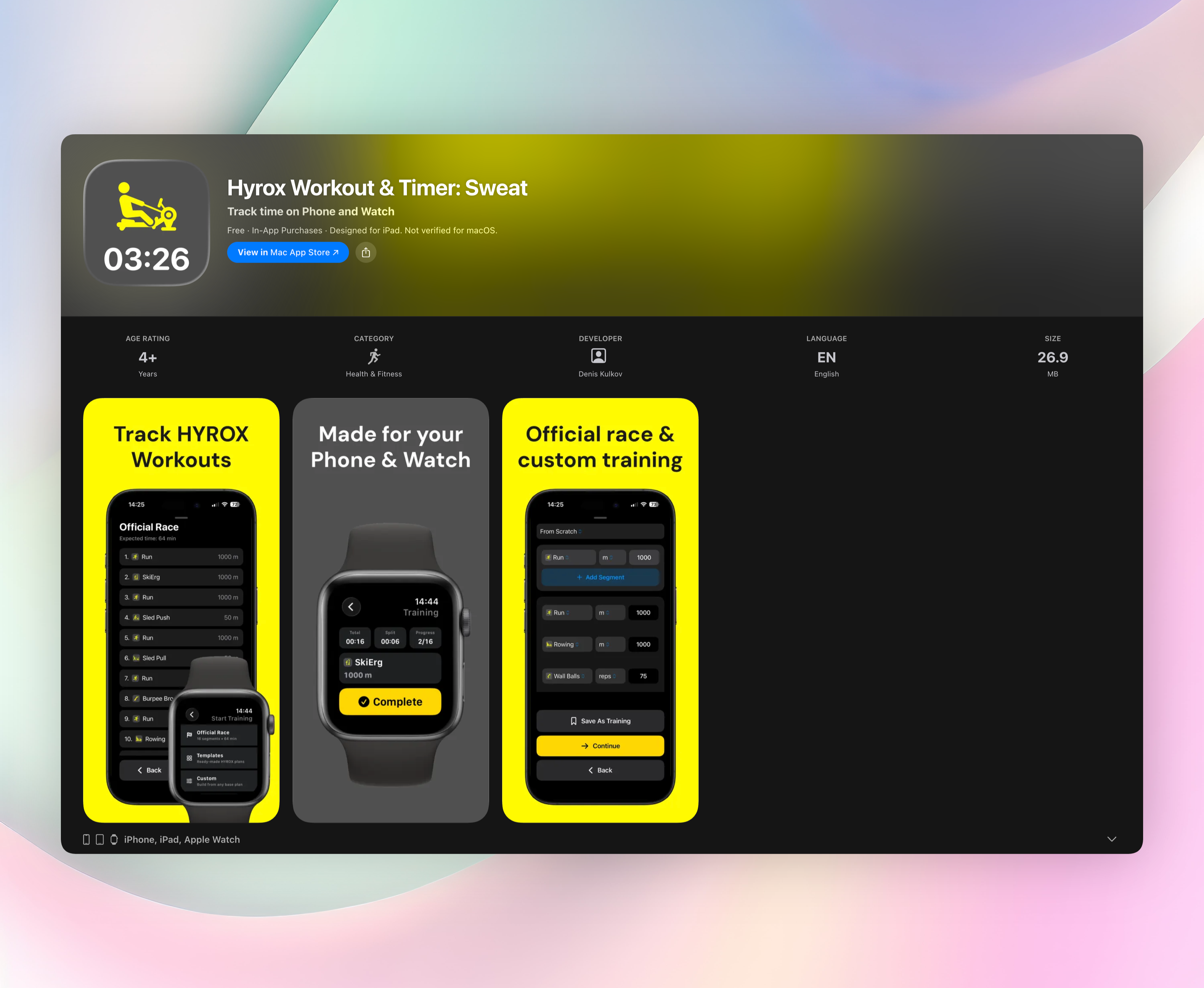
Compromised running holds the other five together, and it lives or dies on timing — the intervals only work if the work and rest blocks are exact and you're not doing arithmetic with a sandbag on your shoulder. I run mine off Hyrox Workout, a HYROX workout timer app for iPhone and Apple Watch, so the clock is somebody else's problem.
Treat that week as a skeleton. The proportions are what matter: two runs, two lifts, one compromised session, one long aerobic piece. A hybrid athlete training plan built for a race will periodize the loading across the build, and a detailed hyrox training plan does exactly that, but the weekly shape stays recognizable underneath.
What hybrid training costs you
You will be slower than a pure runner and weaker than a pure lifter, and there's no version of this where that stops being true. Cut your running to make room for squats and your 10k time goes backwards. Add running to a strength block and your top set comes down. Both of those are the program working, not failing.
The hybrid athlete is optimizing a combined score, and no combined score is won by maximizing one term. What you get back is a body that does two jobs on the same day without either collapsing — which is precisely what a fixed-format race measures.
So judge progress on the combination rather than on either lane alone: your 1km repeat pace immediately after a station, your sled time with your heart rate already high, how fast you're breathing normally again between rounds. Those move in weeks where your 10k PB and your back squat both sit still.
FAQ
Can you build strength and endurance at the same time?
Yes, more slowly than you'd build either alone. Beginners often improve both for months because almost any stimulus works. Trained athletes meet the interference effect sooner, which is when programming — session spacing, modality, volume caps — starts mattering more than effort does.
How many days a week should a hybrid athlete train?
Five or six sessions is the usual shape: two lifts, two to three runs, one compromised or mixed-modal piece. Below five, something gets neglected. Above six, recovery rather than motivation becomes the limiter for anyone who also has a job.
Does hybrid training make you a worse runner?
Slower at the same body weight and effort, usually yes, because running volume is what you traded away. More durable, usually also yes. Strength work is well regarded for running economy and injury resilience, but it doesn't substitute for miles.
Do you have to race HYROX to be a hybrid athlete?
No. HYROX is a convenient benchmark because the format is identical everywhere, so a time in one city compares to a time in another. Any test that scores endurance and strength together does the same job.
How long before hybrid training shows results?
Give it a full block, on the order of 10–12 weeks, before judging. Strength markers often stall first while the aerobic side catches up, then both start moving. Evaluating a block after three weeks tells you nothing except how tired you are.
Free Hyrox Workout tools
- 10K Pacing ChartUse this 10K pacing calculator to turn a target finish time or pace into kilometre-by-kilometre and mile-by-mile splits with cumulative times.
- 5K Pacing ChartEnter a target 5K finish time to see every kilometre or mile split, cumulative time and equivalent pace. This 5k pacing chart also includes common target times for quick reference.
- Concept2 Pace CalculatorUse any two of distance, total time and /500m split to find the missing value, watts, calories per hour and HYROX distance times.
- Half Marathon Pacing ChartCreate a half marathon pacing chart with cumulative 5 km and mile splits, plus the required pace for your target finish.
- HYROX Race Format PlannerChoose a HYROX category and team format to see the full race sequence, running distance, station work and sharing rules.
- HYROX Station Standards ReferenceUse this HYROX stations reference to review the eight stations in race order, with distances, reps and the standards that apply to your division.
- HYROX Finish Time CalculatorThis hyrox time calculator combines your average 1 km run pace, station time and roxzone transit time into a projected finish time and full race timeline.
- HYROX Training Program PlannerCreate a week-by-week HYROX plan with running, erg, strength, station-combination, recovery and simulation sessions.
- Interval Pacing TimerRun repeatable work and rest intervals with a large countdown, clear phase changes and optional audio cues. This pacing timer stays accurate when a tab is backgrounded.
- Marathon Pacing ChartBuild a marathon pacing chart from a target finish time or target pace. See required pace and cumulative times at every 5 km and every mile.
- Running Pace CalculatorUse this running pace calculator to turn a target finish time into clear per-kilometre and per-mile pacing, average speed and splits.
- Split Times CalculatorBuild a cumulative split table for any distance and interval. Compare even pacing with a fade or negative-split strategy and see the required pace for every segment.