HYROX vs CrossFit: the real differences and which is harder
HYROX vs CrossFit in short: HYROX is one fixed race — eight 1 km runs alternating with eight standardized stations, identical at every event worldwide. CrossFit competition is the opposite: an unknown test heavy on gymnastics and barbell skill. One rewards a deep aerobic engine, the other rewards range.
What HYROX actually is: one race, identical everywhere
HYROX is a single format: run 1 km, do a station, repeat eight times. The order never changes: 1000 m SkiErg, 50 m sled push, 50 m sled pull, 80 m burpee broad jump, 1000 m row, 200 m farmers carry, 100 m sandbag lunges, 100 wall balls. That's 8 km of running plus the roxzone transitions, which stay on the clock.
Loads and ball weights change by division — Open, Pro, doubles, relay, age group — but the sequence and distances don't. A time in Hamburg means the same as a time in Dallas. The full race format covers it station by station.
What's missing matters as much as what's there: no barbell, no pull-up bar, nothing that takes six months of drilling before you can attempt it.
What "CrossFit" means in this comparison
CrossFit is a methodology and a gym network, but when people say HYROX vs CrossFit they usually mean the competitive side — the Open and the stages that lead to the Games. Its defining feature is that you don't know the test until shortly before you do it. The movement pool is enormous — snatches, clean and jerks, muscle-ups, handstand walks, rope climbs, pistols, odd objects, sometimes swimming — with efforts from three-minute sprints to hour-long chippers and straight one-rep-max lifts.
HYROX standardizes the test so athletes can be compared; CrossFit randomizes it so the athlete who's best across unknowns wins.
HYROX vs CrossFit vs DEKA at a glance
| HYROX | CrossFit competition | DEKA | |
|---|---|---|---|
| Is the test known? | Yes, always the same | No, announced shortly before | Yes, fixed zones |
| Running | 8 km, broken into eight 1 km legs | Varies; sometimes none | FIT ~5 km, MILE ~1 mile, STRONG none |
| Skill demand | Low — no barbell, no gymnastics | High — olympic lifting, gymnastics | Low to moderate |
| Dominant quality | Aerobic endurance + leg durability | Mixed: power, skill, capacity | Muscular endurance |
| Typical single effort | About an hour to well over 90 minutes | Minutes per event, several per day | Shorter than a HYROX |
| Where people fail | The runs after the sled | A movement they can't do | Pacing the back half of the zones |
Energy systems: a long threshold grind vs repeated spikes
HYROX is aerobic-dominant. You spend the race near threshold, and every station spikes your heart rate before dumping you back onto the track with legs that aren't ready. That's compromised running, and it's the skill the sport tests. Nobody wins a race on station two, but plenty lose one there by pushing the sled too hard for the next three runs to absorb.
CrossFit competition asks for repeated near-maximal efforts and the ability to recover enough to do it again after lunch. Peak power counts — a heavy snatch, a big set of muscle-ups — in a way it never does in HYROX.
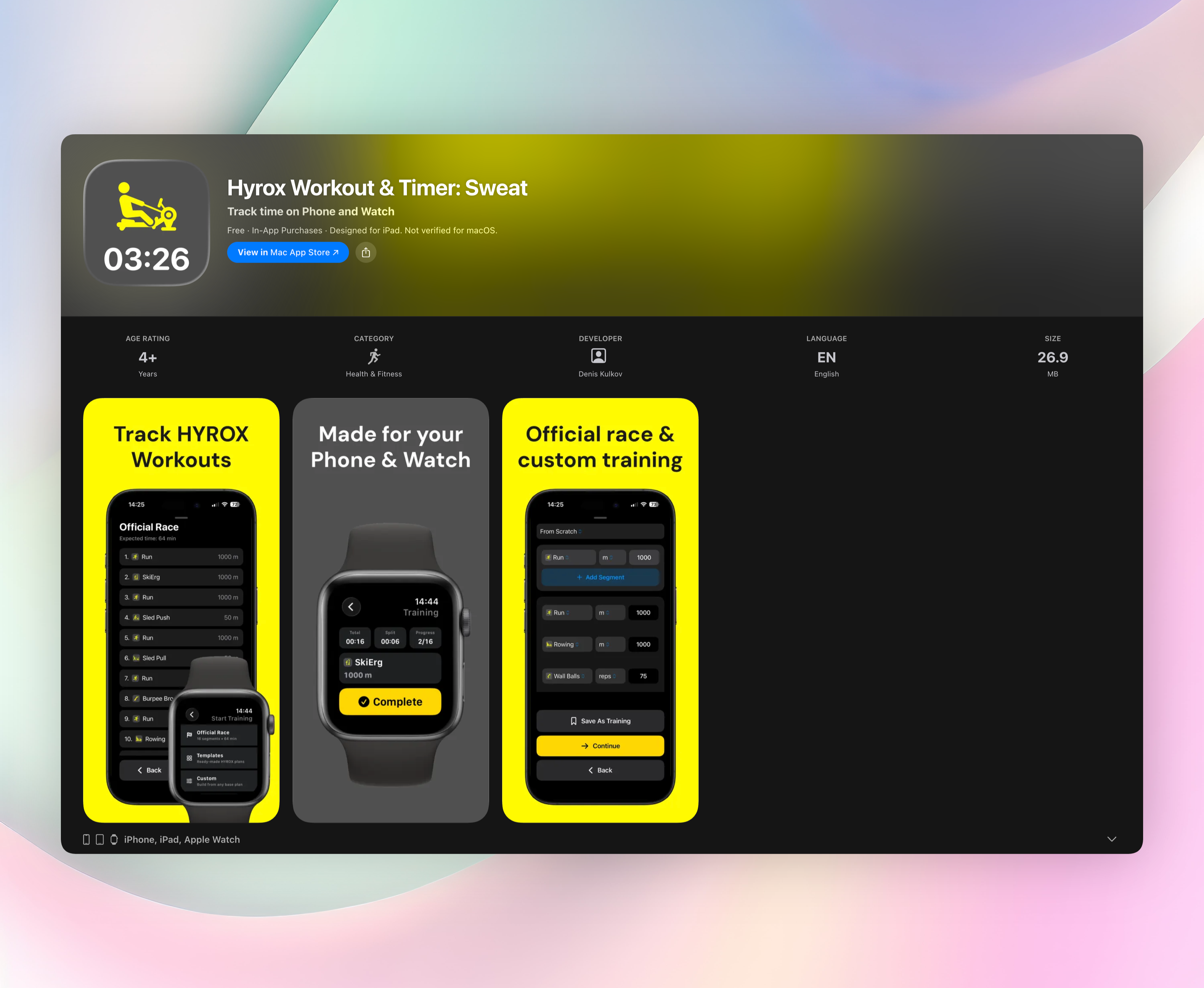
Because the sequence never changes, HYROX training is mostly rehearsal: you're practicing known splits rather than reacting to a surprise. A fixed-sequence tool like Hyrox Workout, a HYROX workout timer app for iPhone and Apple Watch, fits that better than a random-WOD timer, because the thing you're timing is the same every week.
The training weeks look nothing alike
A HYROX week is built around running: a few easy aerobic runs, one threshold or interval session, and at least one brick session pairing stations with runs so your legs learn the transition. Add two lower-body-biased strength sessions — squat, deadlift, split squat, carries — plus targeted station work. A structured HYROX training plan spends almost no time on skill acquisition.
A CrossFit week covers far more ground: olympic-lift technique, gymnastics progressions, a strength piece, conditioning with deliberate variance, accessory work. Aerobic base training matters at the top end now, but no single quality gets the volume a HYROX athlete puts into running.
Who crosses over well, and who gets humbled
CrossFitters who already run tend to do very well. Every HYROX station lives inside CrossFit's movement pool, so nothing is unfamiliar — the shock is the volume of running, not the stations.
Pure runners have the opposite experience. They own the 1 km legs, then meet the sled push, a leg-strength and technique event wearing a cardio costume. Farmers carry and wall balls punish anyone who never squats. Strength athletes look excellent for one station and get taken apart by run four.
HYROX has a low technical floor and a very high aerobic ceiling. CrossFit has a high technical floor — you can't fake a muscle-up — and a ceiling made of breadth.
HYROX vs DEKA: where DEKA sits between them
DEKA, from the Spartan world, is ten zones of functional work, and its three formats differ mainly in how much running gets stitched between them. STRONG has none. MILE puts short shuttles between zones for a mile total. FIT puts roughly 500 m between zones, for about 5 km overall. Missed standards generally cost time penalties rather than a judged no-rep, though check the specifics for your event.
Against HYROX, DEKA is shorter, more varied across its zones, and far less running. Against CrossFit, it's known in advance, so you can rehearse it. If HYROX is a race and CrossFit is an unknown test, DEKA is a standardized circuit — closer to HYROX in spirit.
Is HYROX harder than CrossFit?
Harder at what. HYROX is harder to endure: roughly ninety minutes of continuous discomfort, no event you can quietly write off, and legs that don't come back once you've cooked them. CrossFit is harder to be good at — the skill list takes years, and you can be genuinely fit and still fail a workout because you can't do the movement. HYROX also gives one shot on race day — a bad CrossFit event can be salvaged by the next one.
FAQ
Is HYROX CrossFit?
No. HYROX is one fixed-format race run identically worldwide; CrossFit is a methodology and competition built on varied, unknown workouts. They share movements like wall balls and rowing, but they're separate sports with different rules.
Can CrossFit training alone get me through a HYROX?
Usually, and probably not at the pace you want. You'll handle every station, but 8 km broken into eight fatigued legs is its own skill. Two or three structured runs a week closes most of that gap.
Is HYROX harder than CrossFit?
Depends what you're measuring. HYROX is harder aerobically — a long, evenly paced grind you can prepare for precisely. CrossFit is harder technically, since you're judged on movements that take years to learn, on a test you don't see coming.
What's the difference between HYROX and DEKA?
Both are standardized and repeatable. HYROX is one race — eight runs, eight stations, 8 km of running — while DEKA is ten zones across three formats: no running (STRONG), a mile (MILE), or roughly 5 km (FIT).
Can I train for HYROX at a normal gym?
Mostly. A sled and a SkiErg are the only pieces a standard gym is likely to lack. Hill sprints or a prowler substitute for the sled, and a rower stands in for ski intervals, though get a few sessions on the real equipment before race day.
Free Hyrox Workout tools
- 10K Pacing ChartUse this 10K pacing calculator to turn a target finish time or pace into kilometre-by-kilometre and mile-by-mile splits with cumulative times.
- 5K Pacing ChartEnter a target 5K finish time to see every kilometre or mile split, cumulative time and equivalent pace. This 5k pacing chart also includes common target times for quick reference.
- Concept2 Pace CalculatorUse any two of distance, total time and /500m split to find the missing value, watts, calories per hour and HYROX distance times.
- Half Marathon Pacing ChartCreate a half marathon pacing chart with cumulative 5 km and mile splits, plus the required pace for your target finish.
- HYROX Race Format PlannerChoose a HYROX category and team format to see the full race sequence, running distance, station work and sharing rules.
- HYROX Station Standards ReferenceUse this HYROX stations reference to review the eight stations in race order, with distances, reps and the standards that apply to your division.
- HYROX Finish Time CalculatorThis hyrox time calculator combines your average 1 km run pace, station time and roxzone transit time into a projected finish time and full race timeline.
- HYROX Training Program PlannerCreate a week-by-week HYROX plan with running, erg, strength, station-combination, recovery and simulation sessions.
- Interval Pacing TimerRun repeatable work and rest intervals with a large countdown, clear phase changes and optional audio cues. This pacing timer stays accurate when a tab is backgrounded.
- Marathon Pacing ChartBuild a marathon pacing chart from a target finish time or target pace. See required pace and cumulative times at every 5 km and every mile.
- Running Pace CalculatorUse this running pace calculator to turn a target finish time into clear per-kilometre and per-mile pacing, average speed and splits.
- Split Times CalculatorBuild a cumulative split table for any distance and interval. Compare even pacing with a fade or negative-split strategy and see the required pace for every segment.