HYROX workouts you can actually run in a normal gym
A HYROX workout has one job: teach you to run on legs that are already wrecked, in the order the race demands it. The five sessions below do that with equipment most gyms already have. Each has a target time, so you finish with a result instead of a feeling.
What separates a HYROX workout from a normal WOD
The race is eight 1 km runs alternating with eight stations, always in the same sequence — SkiErg, sled push, sled pull, burpee broad jumps, row, farmers carry, sandbag lunges, wall balls — and a run comes before every one of them. You never reach a station fresh and you never start a run fresh. The full station sequence doesn't change from race to race.
That's the whole training problem. A heavy sled day on its own, and tidy 1 km repeats on their own, make you good at two things the race never asks for cold. A HYROX WOD worth doing either pairs a run with a station or stacks enough stations to reproduce that fatigue.
Keeping the HYROX workout order intact matters for simulations. Training out of sequence is fine for skill work, but race order teaches you where you can spend (SkiErg, row) and where you'll detonate (sled push into a run).
Workout 1: the half-HYROX simulation
Two versions circulate. Stations 1–4 at full distance with four 1 km runs, or all eight stations at half volume with 500 m runs. The first teaches more, because the sleds stay at race weight.
- 1 km run → 1000 m SkiErg
- 1 km run → 50 m sled push
- 1 km run → 50 m sled pull
- 1 km run → 80 m burpee broad jumps
Target: under 45 minutes at your division's weights — the pace math for a 90-minute race.
No SkiErg? Row 1000 m instead — your legs take more of that than they would on the ski, so the push behind it won't feel like race day.
Workout 2: the full race simulation
A full HYROX simulation workout is expensive. Run it once, roughly three weeks out, and not again before race day; it takes real recovery days out of the block. All eight stations, race order, race weights, and a clock that never stops. Walk your transitions if you need to, but hold each under 30 seconds, because Roxzone time is scored time in the real thing.
This is the closest you'll get to a HYROX competition workout without a bib. Log every split. The gap between your first 1 km and your last tells you more about your race than the finish number does, and it's the gap training actually moves.
Workout 3: run–station couplets for compromised running
The highest-return session here, and the one you can run almost anywhere. Eight rounds of: 600 m run, straight into the station, then 60 seconds rest.
- Rounds 1–2: 25 m sled push
- Rounds 3–4: 25 m sled pull
- Rounds 5–6: 25 wall balls
- Rounds 7–8: 20 m burpee broad jumps
Target: your round-8 run split within 10 seconds of round 1. Total time isn't the standard here — drift is. If round eight is 40 seconds slower, you started too fast, and the fix is a slower round one, not more rounds.
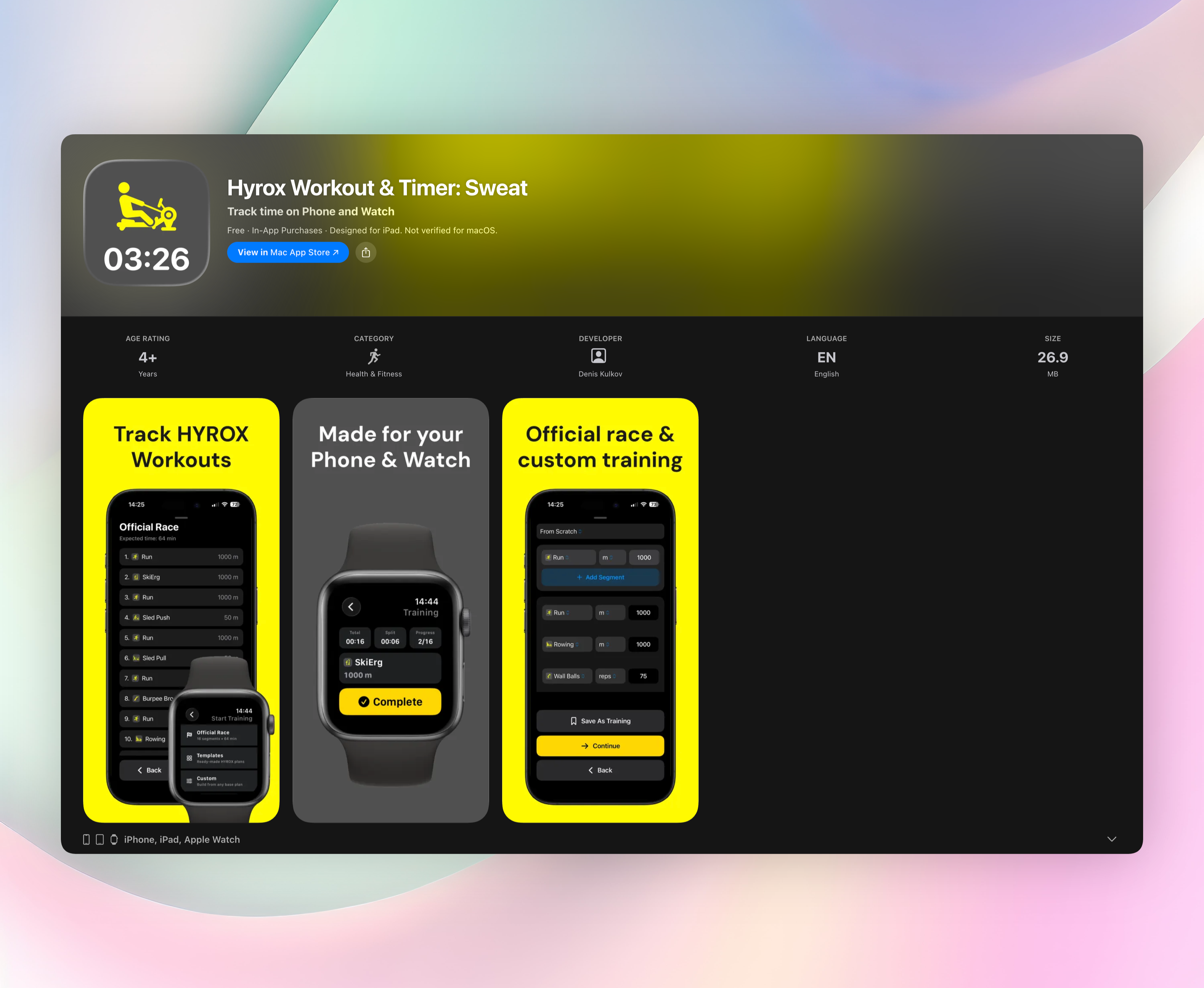
Every session here is written as station and rest durations rather than a rep list, which is the format Hyrox Workout, a HYROX workout timer app for iPhone and Apple Watch, times on the wrist — so you're not restarting a phone stopwatch between rounds.
Workout 4: sled day
Sled push is where most amateurs bleed time, and gym floors lie. Turf, rubber, and race flooring all push differently, so your gym time won't transfer to the venue. Train the effort, not the number.
- 5 × 50 m sled push at race weight, 2 minutes rest
- 5 × 50 m sled pull at race weight, 90 seconds rest
- 4 × 400 m run at goal race pace, 60 seconds rest
Target: no push more than 10 seconds slower than your first. If push five falls apart, the load is above your current sled fitness — strip 20 kg and keep the standard rather than grinding out a failed rep.
No sled? Push an unpowered treadmill belt by hand in 2-minute blocks, or run 40 m of heavy walking lunges straight into 20 leg-press reps. Neither reproduces horizontal drive, but both cook the same quads.
Workout 5: wall balls under fatigue
The individual race ends with 100 wall balls. Divisions change the ball and the target, not the rep count: men's Open throws 6 kg to a 10 ft target, women's Open 4 kg to 9 ft, and the Pro divisions add ball weight at the same heights. People fail this station because they only ever train it fresh.
- 1 km run → 50 wall balls
- 500 m run → 30 wall balls
- 400 m run → 20 wall balls
Target: under 14 minutes, with no set smaller than 10. Falling to singles means your squat pattern quit before your lungs did — a positioning problem that extra conditioning won't fix.
Equipment substitutions that actually work
| Station | Substitute | Match it by | What the swap loses |
|---|---|---|---|
| SkiErg 1000 m | Row 1000 m, or 4 minutes hard on an assault bike | Time under effort | Upper-body fatigue heading into the push |
| Sled push 50 m | Unpowered treadmill belt push, 2-minute blocks | Continuous leg drive | Friction and body angle |
| Sled pull 50 m | Rope-to-plate drag, or seated hand-over-hand cable pulls | Grip time under tension | Sled inertia |
| Burpee broad jumps 80 m | Same movement, any 20 m stretch, out and back | Total distance | Nothing — this one travels |
| Row 1000 m | SkiErg 1000 m, or 2000 m on an assault bike | Time under effort | Leg drive |
| Farmers carry 200 m | Dumbbells or kettlebells at your division's load — 2 × 24 kg men's Open, 2 × 16 kg women's Open | Distance without setting down | Handle thickness, most of the grip challenge |
| Sandbag lunges 100 m | Barbell back-rack lunges, or a weighted vest plus dumbbells | Step count and distance | Bag instability |
| Wall balls | Any med ball, target height taped on the wall | Reps and height | Nothing |
Substitute by duration and by what fatigues, never by muscle group alone. Swapping the row for lunges because "both hit the legs" trains something, just not the race.
How to place these in a training week
Two of these alongside your running is plenty. A workable split is one couplet session, one station-heavy day (sled or wall balls), two easy runs, and one long run. Slot the half simulation in every third or fourth week; the full simulation once. If you're building a structured training plan, couplets are the session you protect when the week gets busy.
A beginner HYROX workout starts at workout three with 400 m runs, half sled weight, and six rounds instead of eight. Add distance before you add load — the runs break down long before the stations do.
FAQ
How often should I run a full race simulation?
Once per race prep, roughly three weeks out. Treat it as a test, not a workout: the recovery cost is high, and a half simulation every three or four weeks teaches you most of the same lessons for a fraction of the price.
Can I train for HYROX without a sled or SkiErg?
Yes, and plenty of people do. Substitute by effort duration rather than movement shape — an unpowered treadmill push for the sled, a rower for the SkiErg. Get two or three sessions on real equipment in the final month, so race day isn't your first sled.
Should HYROX workouts follow the race order?
For simulations, yes — the sequence is fixed, and rehearsing it is half the point. For everything else, no. Couplets and station work are more useful when you deliberately pair running with whichever station you're worst at.
How long should one of these sessions take?
Couplets run 45 to 60 minutes with a warm-up. The half simulation is 40 to 50 minutes of work. The full simulation takes as long as your race would, so plan on 90 minutes or more if it's your first.
What weight should I train the sleds at?
Race weight, whenever you can hold the standard. Sled loads are set per division and the published numbers include the sled itself, so check the figure for the division you entered rather than the plates you can see. If 50 m takes you well over a minute, train lighter and build toward it.
Free Hyrox Workout tools
- 10K Pacing ChartUse this 10K pacing calculator to turn a target finish time or pace into kilometre-by-kilometre and mile-by-mile splits with cumulative times.
- 5K Pacing ChartEnter a target 5K finish time to see every kilometre or mile split, cumulative time and equivalent pace. This 5k pacing chart also includes common target times for quick reference.
- Concept2 Pace CalculatorUse any two of distance, total time and /500m split to find the missing value, watts, calories per hour and HYROX distance times.
- Half Marathon Pacing ChartCreate a half marathon pacing chart with cumulative 5 km and mile splits, plus the required pace for your target finish.
- HYROX Race Format PlannerChoose a HYROX category and team format to see the full race sequence, running distance, station work and sharing rules.
- HYROX Station Standards ReferenceUse this HYROX stations reference to review the eight stations in race order, with distances, reps and the standards that apply to your division.
- HYROX Finish Time CalculatorThis hyrox time calculator combines your average 1 km run pace, station time and roxzone transit time into a projected finish time and full race timeline.
- HYROX Training Program PlannerCreate a week-by-week HYROX plan with running, erg, strength, station-combination, recovery and simulation sessions.
- Interval Pacing TimerRun repeatable work and rest intervals with a large countdown, clear phase changes and optional audio cues. This pacing timer stays accurate when a tab is backgrounded.
- Marathon Pacing ChartBuild a marathon pacing chart from a target finish time or target pace. See required pace and cumulative times at every 5 km and every mile.
- Running Pace CalculatorUse this running pace calculator to turn a target finish time into clear per-kilometre and per-mile pacing, average speed and splits.
- Split Times CalculatorBuild a cumulative split table for any distance and interval. Compare even pacing with a fade or negative-split strategy and see the required pace for every segment.