How to build a HYROX training plan
A HYROX training plan needs four to six sessions a week split across running, strength, and station work, arranged in three blocks: general base, race-specific, then a taper. How long you need depends on your running base — around 8 weeks if you already run, 16 or more if you don't.
What the race actually asks of you
HYROX is eight 1 km runs, each one followed by a workout station, in an order that never changes: SkiErg, sled push, sled pull, burpee broad jumps, row, farmers carry, sandbag lunges, wall balls. Eight kilometers of running, chopped into eight pieces, with your legs already loaded before every single one.
Everything about how to train for HYROX comes out of that structure. Running is the largest block of time on the clock for nearly everyone, so it gets the largest block of your week. And those runs are never fresh — the skill you're actually building is running decently on legs that just did 100 m of sandbag lunges. That's compromised running, and a standard 10k program won't give it to you.
Then there's the Roxzone. The clock keeps running between the run and the station, so walking, hunting for a free sandbag, or standing over the sled is all race time. Transitions are the cheapest minutes in the sport. Learn the order of the stations before you write a single session.
How many sessions a week
Four is the floor for a first race. Five or six is where most people land. More than six and you're usually stealing recovery from the sessions that matter.
A workable split at five sessions:
- Two runs. One easy aerobic run, one quality run (intervals or threshold).
- Two strength sessions. Full-body, with a heavy hinge, a heavy squat pattern, and real pulling volume.
- One hybrid session. Runs and stations alternating, the closest thing to the race itself.
At four sessions, fold the lifting into a single full-body day. At six, add a second easy run rather than a second hard one — extra aerobic volume is what most people are missing, and it's the cheapest adaptation to buy.
The ratio matters more than the total. Roughly half your weekly training time should be running or running-adjacent. People coming from lifting almost always get this backwards and spend twelve weeks getting stronger at stations they were already fine at.
The three blocks of a 12-week build
A HYROX 12 week training plan splits cleanly into three phases, and the mistake most people make is running phase three from day one.
Weeks 1–4: base
Build aerobic capacity and general strength. Runs are mostly easy, with one weekly session of longer intervals — 5 to 6 minutes at a hard but controlled effort. Strength stays general: squat, deadlift or RDL, weighted lunges, pull-ups, overhead press. Stations appear only as skill work — a few sets of wall balls to find a rhythm, sled pushes to find the body angle, SkiErg to learn to drive with your hips instead of your triceps.
Nothing in this block should feel like a race. If you're gassed at the end of every session in week 2, you've started at week 9.
Weeks 5–9: race-specific
Intervals shorten toward race pace and get paired with stations. A typical specific session: 1 km run at goal pace, straight into a station, straight back out to the next kilometer, four to six rounds. Keep the transitions honest — walk them, don't rest through them.
Strength narrows to what the stations demand. Heavy sled pushes and pulls if you have access to a sled. Lunge volume that matches or exceeds the race's 100 m. Farmers carries long enough that grip fails before your legs do. Wall balls in sets you can hold — the Open standard is 100 reps for men and 75 for women, and chasing them unbroken in a first race costs more than it saves. Sets of 15 to 20 with 15 seconds of rest hold up better.
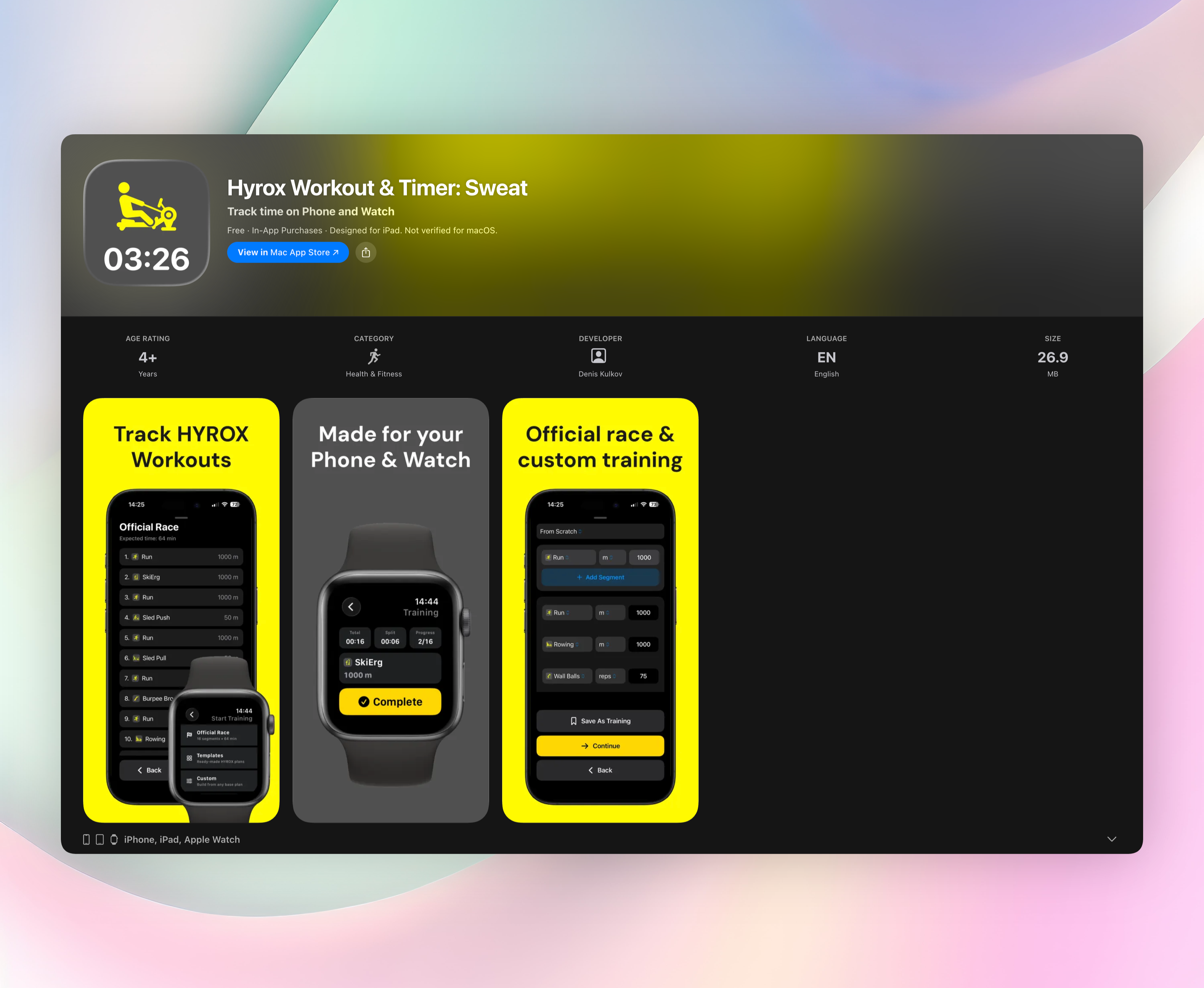
Late in this block, run one full race simulation. All eight runs, all eight stations, in order, clock never stopped. This is the most informative session in the whole build, and the one people quietly fake by resetting the timer between efforts. Hyrox Workout, a HYROX workout timer app for iPhone and Apple Watch, is an easy way to run the eight stations in order with real transition timing instead of stopping the clock between efforts.
Use the result to set a goal that's real rather than hopeful — your split against typical finish times tells you more than any number you picked in week 1.
Weeks 10–12: sharpen and taper
Cut volume by roughly a third to a half across the final two weeks and keep the intensity. Hold the quality run and one short station session; drop the easy volume and the heavy lifting. Your last full simulation should sit 14 to 21 days out, not the weekend before. The final week is short race-pace touches, mobility, and sleep.
Sample week: a HYROX training plan for beginners
Four sessions, no sled required.
- Mon — Easy run, 30–40 min, conversational pace
- Tue — Full-body strength: squat 4×6, RDL 3×8, walking lunges 3×20 steps, pull-ups 4× max, then 5×15 wall balls
- Thu — Quality run: 6×3 min hard, 90 s jog recovery
- Sat — Hybrid: 4 rounds of 800 m run + one station, rotating SkiErg, burpee broad jumps, row, wall balls
Rest or walk the other days. Hold this for four to six weeks before adding anything. If easy runs still feel hard by week 4, add a fifth easy run, not a fifth hard one.
Sample week: returning athlete
Six sessions, mid-specific block, for someone who has raced before or has a solid running and lifting base.
- Mon — Lower strength: back squat 5×3, RDL 4×6, sled push 8×25 m heavy, 3×60 s weighted lunge holds
- Tue — Compromised running: 6 rounds of 1 km at goal race pace + one station in race order, walk the transitions
- Wed — Easy run 50–60 min + grip work (dead hangs, farmers carries 4×200 m)
- Thu — Upper and pull: weighted pull-ups, single-arm rows, overhead press, SkiErg 5×500 m at race effort
- Fri — Easy 40 min or rest
- Sat — Long run 75–90 min, or the back half of the race (stations 5–8 with runs)
- Sun — Off
Every fourth week, cut total volume by a third. Hybrid training accumulates fatigue in two systems at once, and the deload is what stops that becoming an injury in week 9.
How long to train for HYROX
How long you need depends almost entirely on your running base, because running is the slowest thing to build. Strength adapts in weeks; tendons and aerobic capacity take months.
| Starting point | Main limiter | Realistic prep | Sensible first goal |
|---|---|---|---|
| Runs 20+ km/week, some lifting | Station technique, sled | 8–10 weeks | Run every kilometer without a walk break |
| Lifts regularly, barely runs | Running volume, tendon load | 14–16 weeks | Finish without a run-walk spiral |
| Neither, starting from scratch | General aerobic base | 16–20 weeks | Finish, comfortably |
| Has raced HYROX before | Race-specific sharpness | 6–8 weeks | Beat your last time |
Those windows assume consistent weeks, not perfect ones. Missing a session resets nothing; missing three weeks does. With less time than the table suggests, shorten the base block rather than the specific one — race-familiar and underprepared beats fit and confused.
Check the loads early. The sled and the sandbag are the two stations that most often turn a first race into a walk, and both change between Open and Pro and between men's and women's divisions. Look up your division's weights in week 1 and train those numbers, not generic ones.
FAQ
How many days a week should I train for HYROX?
Four at a minimum, five or six for most people. The split matters more than the count — roughly half running, the rest strength and station work. A seventh session rarely helps as much as making the five you already do consistent.
Can I train for HYROX without a gym?
Partly. Running, burpee broad jumps, lunges, and wall balls against a wall with a medicine ball all work outdoors. The sled, SkiErg, and rower have no real substitutes — steep treadmill walks, heavy carries, and hill sprints get you close on the sled, but plan at least one gym session a week if you can.
How long to train for HYROX if I'm already a runner?
Eight to ten weeks is usually enough. Your limiter is grip, lunge volume, and sled technique rather than fitness, so weight your program toward strength and station skill and keep just enough running to hold your aerobic base.
Is a HYROX training program different for the Pro division?
The structure is identical; the loads aren't. Pro raises the sled, farmers carry, sandbag, and wall ball weights, which pushes station time up and makes strength a bigger share of your week. Race Open first unless you can already hold unbroken sets at Pro weights.
How often should I do a full race simulation?
Once or twice in a 12-week build, and never in the final two weeks. A full simulation costs close to what a race costs — it takes real recovery. Partial simulations of four runs and four stations are the better weekly tool.
Free Hyrox Workout tools
- 10K Pacing ChartUse this 10K pacing calculator to turn a target finish time or pace into kilometre-by-kilometre and mile-by-mile splits with cumulative times.
- 5K Pacing ChartEnter a target 5K finish time to see every kilometre or mile split, cumulative time and equivalent pace. This 5k pacing chart also includes common target times for quick reference.
- Concept2 Pace CalculatorUse any two of distance, total time and /500m split to find the missing value, watts, calories per hour and HYROX distance times.
- Half Marathon Pacing ChartCreate a half marathon pacing chart with cumulative 5 km and mile splits, plus the required pace for your target finish.
- HYROX Race Format PlannerChoose a HYROX category and team format to see the full race sequence, running distance, station work and sharing rules.
- HYROX Station Standards ReferenceUse this HYROX stations reference to review the eight stations in race order, with distances, reps and the standards that apply to your division.
- HYROX Finish Time CalculatorThis hyrox time calculator combines your average 1 km run pace, station time and roxzone transit time into a projected finish time and full race timeline.
- HYROX Training Program PlannerCreate a week-by-week HYROX plan with running, erg, strength, station-combination, recovery and simulation sessions.
- Interval Pacing TimerRun repeatable work and rest intervals with a large countdown, clear phase changes and optional audio cues. This pacing timer stays accurate when a tab is backgrounded.
- Marathon Pacing ChartBuild a marathon pacing chart from a target finish time or target pace. See required pace and cumulative times at every 5 km and every mile.
- Running Pace CalculatorUse this running pace calculator to turn a target finish time into clear per-kilometre and per-mile pacing, average speed and splits.
- Split Times CalculatorBuild a cumulative split table for any distance and interval. Compare even pacing with a fade or negative-split strategy and see the required pace for every segment.