HYROX sled push weight, distance and technique
The HYROX sled push weight, sled included, is 102 kg for women's open, 152 kg for men's open and women's pro, and 202 kg for men's pro. The distance is 50 m in every division — four lengths of 12.5 m, with the same layout for the pull.
HYROX sled push weight and sled pull weight by division
Both are published as totals including the frame, so the plates you'd stack on a gym sled to match are lighter than the headline number.
| Division | Sled push — 50 m | Sled pull — 50 m |
|---|---|---|
| Women open | 102 kg (225 lb) | 78 kg (172 lb) |
| Men open | 152 kg (335 lb) | 103 kg (227 lb) |
| Women pro | 152 kg (335 lb) | 103 kg (227 lb) |
| Men pro | 202 kg (445 lb) | 153 kg (337 lb) |
Men's open and women's pro share a tier, which is why the same 152 kg push turns up in two different races. Doubles and relay carry their own published loads, so read the table for the division you actually entered. The full grid across all eight stations is in the station weights breakdown.
Why the sled feels far heavier than the plate math suggests
Weight decides how hard the sled presses into the floor. What you fight is friction — that weight multiplied by whatever the surface gives you. Event flooring isn't identical in every hall, so the same HYROX sled weight genuinely moves differently from one city to the next.
Two things stack on top. A stationary sled takes more force to start than a moving one takes to keep going, so every stall restarts you at the hardest part. And you arrive straight off a 1 km run — the push after run two, the pull after run three — so a load you can shift cold in the gym is not the load you meet on race day. That's why the push wrecks more races than the pull.
HYROX sled push technique: hands, body angle, stride
Most HYROX sled push tips collapse into one instruction — don't let it stop. The rest is mechanics that make that possible.
Arms straight, elbows locked. Bent arms turn the push into a chest press and leak force out of the chain before it reaches the sled. Your arms are struts, not engines.
Grip low, body long. Holding lower on the uprights drops you into a flatter line from heel to head, sending more force horizontally instead of straight down into the floor. A tall, upright push loads the ground and moves nothing. The heavier it feels, the lower you want to be; if it's moving easily, a higher grip lets the legs turn over faster. Head neutral, eyes a couple of meters ahead — looking down rounds the back and shortens the drive.
Short, fast steps on the forefoot. Long strides feel powerful and stall the sled between contacts. Heels stay off the ground, the rear leg extends fully, the legs turn over quickly — closer to a hill sprint than a squat.
At the end of each length the whole sled has to cross the line before you turn it, so drive it through rather than easing off on approach. Stopping a foot short means restarting from dead stop with the turn still ahead. Both sleds' movement standards sit in the rules and standards guide.
HYROX sled push distance: how to break up the 50 m
The HYROX sled push distance is 50 m, run as four 12.5 m lengths, and the three turns are break points whether you plan them or not. Faster athletes push each length unbroken and use the turn as the rest. Everyone else plans a stop mid-length: two pushes per length on the heavy tiers, one on the light.
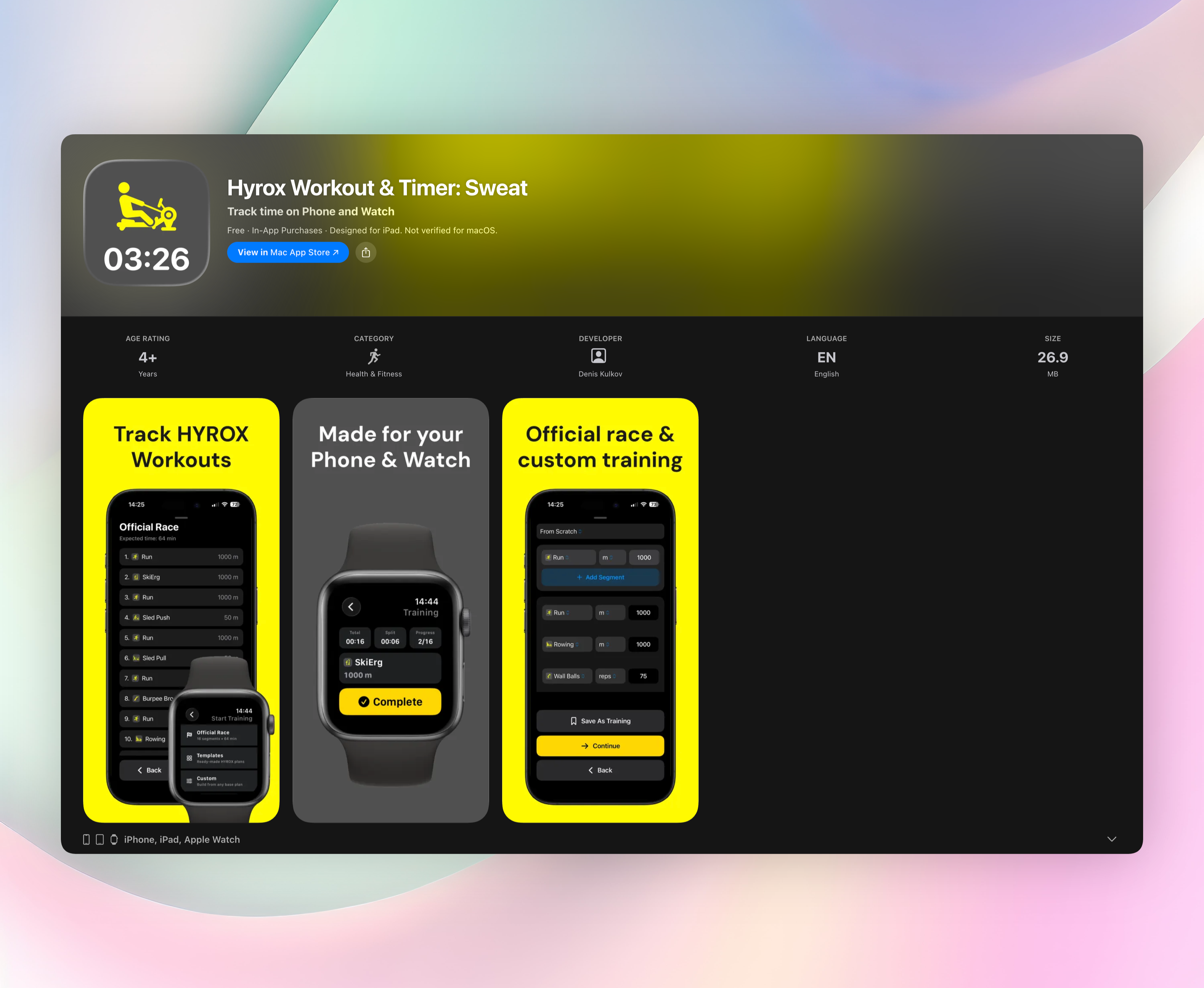
Decide before race day, and decide in seconds, not by feel. Ten seconds at the sled is a rest; the same pause judged by feel is usually thirty, and by the third length it's a minute. Hyrox Workout, a HYROX workout timer app for iPhone and Apple Watch, holds those breaks to a set number of seconds in training so the brief one doesn't quietly become ninety.
The sled pull: same distance, different problem
The HYROX sled pull weight is 78 kg, 103 kg or 153 kg by tier, over the same 50 m in 12.5 m lengths. You work from inside a marked box and stay in it while the sled is moving — drift a foot outside and the judge stops you until you're back in. Pull hand over hand, then walk the rope back out to the sled for the next length.
Moving it is a leverage problem more than a strength one. Sit the hips back and let your bodyweight fall away from the rope so your mass does the work and your arms only reposition. Take the rope high, finish low. Grip fails before the back does, which argues for fewer, longer hand-over-hands, not frantic short ones. The rope walk-out is dead time: jog it, don't stroll it.
Training sleds when your gym's is light — or nonexistent
If your sled is too light, add load before you add distance: plates, sandbags, a training partner standing on the deck. Then push on the grippiest surface you're allowed to use: a light sled on turf or carpet can be harder work than a heavy one on slick vinyl. You can't know the venue floor in advance, so train across more than one.
No sled at all leaves three decent substitutes:
- Treadmill pushes. On a curved manual belt — or a motorized one switched off, if your gym permits — hold the front rail and drive with the same locked-arm, flat-body position.
- Heavy leg press and walking lunges, in 30–60 second efforts rather than low reps. The station is a sustained quad burn, not a one-rep max.
- Wall drives. Hold your push position against a wall 20–30 seconds per side, alternating the drive leg. Free, and it fixes body angle faster than anything on wheels.
For the pull, a rope on a loaded sled, plate stack or weighted mat covers the pattern; heavy rows and pulldowns cover the rest. Grip work isn't optional — that's what runs out first.
Whatever you use, do it tired — a sled session at the top of a fresh training day tests something the race never asks. Slot one or two into the week where your training plan already schedules run intervals, and hit the sled off the last rep.
FAQ
How much does the HYROX sled push weigh?
102 kg for women's open, 152 kg for men's open and women's pro, and 202 kg for men's pro, sled included. Every division pushes the same 50 m.
How long is the HYROX sled push?
50 meters, split into four lengths of 12.5 m. The whole sled has to cross the line at the end of a length before you turn it around.
Why can I push more in the gym than at a race?
Friction and fatigue. Venue flooring differs from your gym floor, and the sled comes straight off a 1 km run with your legs already loaded. Restarting a stalled sled also takes more force than keeping a rolling one moving.
Are the sled weights the same in doubles?
Not automatically — doubles is published as its own set of loads, so check the table for your division rather than assuming the singles numbers. The distance is still 50 m per sled, with partners splitting it however they like.
What improves the sled push fastest?
Position, then strength. Locked arms and a long, low body line usually buy more than extra leg work. After that, heavy sleds in short repeated efforts off a run, once or twice a week.
Free Hyrox Workout tools
- 10K Pacing ChartUse this 10K pacing calculator to turn a target finish time or pace into kilometre-by-kilometre and mile-by-mile splits with cumulative times.
- 5K Pacing ChartEnter a target 5K finish time to see every kilometre or mile split, cumulative time and equivalent pace. This 5k pacing chart also includes common target times for quick reference.
- Concept2 Pace CalculatorUse any two of distance, total time and /500m split to find the missing value, watts, calories per hour and HYROX distance times.
- Half Marathon Pacing ChartCreate a half marathon pacing chart with cumulative 5 km and mile splits, plus the required pace for your target finish.
- HYROX Race Format PlannerChoose a HYROX category and team format to see the full race sequence, running distance, station work and sharing rules.
- HYROX Station Standards ReferenceUse this HYROX stations reference to review the eight stations in race order, with distances, reps and the standards that apply to your division.
- HYROX Finish Time CalculatorThis hyrox time calculator combines your average 1 km run pace, station time and roxzone transit time into a projected finish time and full race timeline.
- HYROX Training Program PlannerCreate a week-by-week HYROX plan with running, erg, strength, station-combination, recovery and simulation sessions.
- Interval Pacing TimerRun repeatable work and rest intervals with a large countdown, clear phase changes and optional audio cues. This pacing timer stays accurate when a tab is backgrounded.
- Marathon Pacing ChartBuild a marathon pacing chart from a target finish time or target pace. See required pace and cumulative times at every 5 km and every mile.
- Running Pace CalculatorUse this running pace calculator to turn a target finish time into clear per-kilometre and per-mile pacing, average speed and splits.
- Split Times CalculatorBuild a cumulative split table for any distance and interval. Compare even pacing with a fade or negative-split strategy and see the required pace for every segment.