HYROX training equipment: the full kit and honest substitutes
The HYROX training equipment list is short: a SkiErg, a Concept2 rower, a weighted sled, a sandbag, farmers carry handles, and a wall ball thrown to a fixed target — plus open floor to run and jump on. Most gyms stock three or four. Everything else is substitution.
The eight pieces of HYROX training equipment the race uses
Every race runs the same eight stations in the same order, each one preceded by its own 1 km run — eight legs, 8 km of running in total, roughly half the event.
- SkiErg — 1,000 m, the opening station. Concept2, damper wherever you like.
- Weighted sled, pushed — 50 m, often broken into shorter lanes (commonly 12.5 m) depending on the venue.
- The same sled, pulled by rope — 50 m, hand over hand from inside a marked box.
- Open floor — 80 m of burpee broad jumps, no gear beyond space.
- Concept2 rower — 1,000 m, straight after the burpee broad jumps.
- Farmers handles or kettlebells — 200 m, one in each hand. You may set them down, but you restart from where you dropped them.
- Sandbag — 100 m of walking lunges with it across your shoulders.
- Wall ball and a target — 100 reps, roughly 3 m (10 ft) for men and 2.75 m (9 ft) for women.
Load depends on division. Open men push 152 kg and pull 103 kg (sled included), lunge a 20 kg bag, carry 2 × 24 kg and throw a 6 kg ball. Open women are at 102 kg, 78 kg, 10 kg, 2 × 16 kg and 4 kg. Pro is a tier heavier throughout — the station weights matter more than the brand of kit.
What your gym is probably missing
CrossFit boxes have wall balls, a rower, kettlebells and usually a sandbag, but often no SkiErg and no room to push a sled 50 m. Commercial gyms have rowers and sometimes a turf sled, but no 3 m target and nothing that pulls. If you're doing HYROX training at home, you have shoes and a floor — the substitutions below are rated by how much of the real stimulus survives, not by how hard they feel.
HYROX training equipment substitutions and how well they hold up
| Station | Race equipment | Best substitute | Fidelity |
|---|---|---|---|
| 1,000 m SkiErg | Concept2 SkiErg | Band pulldowns or heavy rope work, 4 min hard | Low |
| 50 m sled push | Weighted sled on carpet | Dead-mill treadmill push, or 30 s hill sprints | High |
| 50 m sled pull | Sled and rope | Heavy seated cable row, long sets | Medium |
| 1,000 m row | Concept2 RowErg | Air bike or hard run at the same duration | Low |
| 80 m burpee broad jumps | Floor | Floor | Exact |
| 200 m farmers carry | Two handles | Two kettlebells, dumbbells or loaded bags | High |
| 100 m sandbag lunges | Sandbag | Backpack loaded to division weight | High |
| 100 wall balls | Ball and 3 m target | Dumbbell thruster with a jump | Medium |
Sled push: the easiest station to fake well
Kill the treadmill's power, grab the handles and push the belt for 20 to 30 seconds. Or find a hill steep enough to force a forward lean and run it hard for 30 to 40. Both keep the leg burn and heart rate you carry into the next kilometer. What they lose is the horizontal load through your arms — race sleds don't run on gym turf. Train heavier than the published number, not lighter.
Sled pull: it's a row, not a pulldown
You stand in a box and haul the sled to you hand over hand, so the work is a repeated heavy horizontal pull under grip fatigue with heavy isometric bracing. A seated cable row at a weight you can only grind for 20 to 25 reps is the closest gym stand-in; a lat pulldown is the wrong plane and teaches nothing useful. Technique details are in sled push and pull.
Wall balls: keep the depth, lose the ball
Hold one dumbbell at your chest, squat to depth, drive up and let the press finish hard enough that your feet leave the floor. That reproduces the leg drive and the shoulder fatigue. What it can't reproduce is the catch — absorbing the ball and immediately squatting under it is what destroys legs around rep 60. A medicine ball thrown to a chalk mark gets closer even at the wrong height. Depth is the standard people get no-repped on, so train to it from day one.
Sandbag lunges: a backpack is nearly as good
Fill a hiking pack with plates, sand or water and lunge 100 m, carrying it across your shoulders rather than on your back. A pack riding low sits closer to your center of mass than a bag over your traps, which makes it easier than the real thing. Every step is still knee-to-floor.
The ergs are the hardest to fake
Nothing built from free weights gives you a four-minute, lat-and-triceps-driven machine effort. Band pulldowns hit the muscles without the aerobic cost; an air bike delivers the cost through the wrong limbs. Rowing is easier to approximate — a bike or hard run at least loads the legs — but stroke rhythm and damper feel still need the machine itself. Reach a real erg every couple of weeks and spend that session on pacing, not volume.
The minimum viable HYROX home gym
Three things cover almost everything:
- One pair of kettlebells at your farmers carry weight — 2 × 24 kg for Open men, 2 × 16 kg for Open women.
- One sandbag filled to your division's lunge weight. An adjustable-fill bag beats a fixed one if you might change divisions.
- A route to run. Half the race is running, and it's the half most people under-train. A measured 1 km loop from your door outperforms any machine you could buy.
A HYROX workout at home built on that kit is missing the two ergs and nothing else.
Making a partial setup rehearse the real race
What a HYROX home workout usually gets wrong isn't the movement selection, it's the clock. In competition you don't rest between the run and the station — you cross the transition zone and start working. So a substitute's value isn't how similar it looks, it's whether it occupies about the same slice of time as the station it replaces. If your sled push would take 90 seconds on race day, your hill sprints get 90 seconds, then you run.
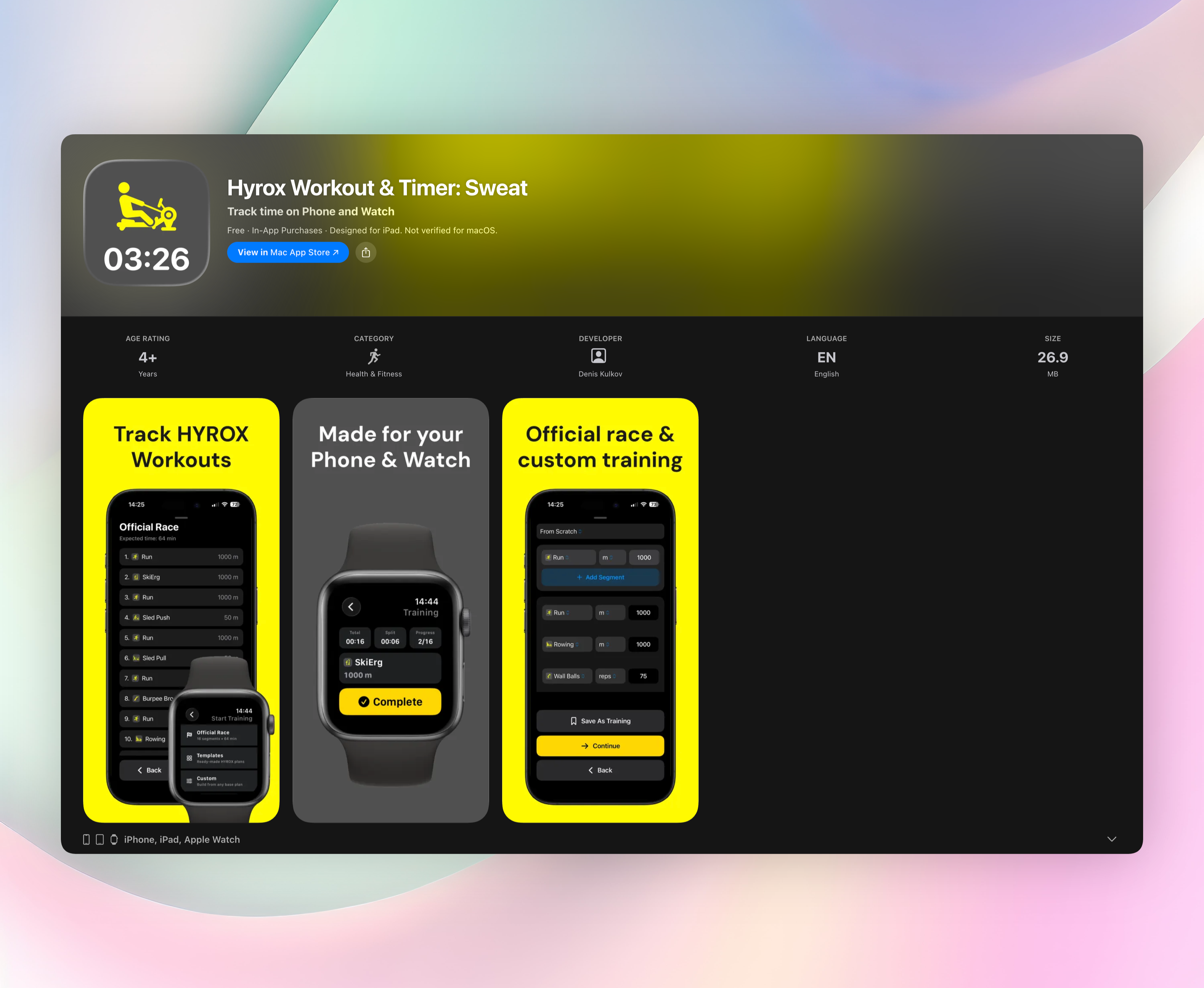
Hyrox Workout is a HYROX workout timer app for iPhone and Apple Watch, and that's where it earns its place — substituted stations get timed against the real race distances, so a session in a garage still rehearses the same work-to-transition ratio.
FAQ
Can you do HYROX training without equipment?
Running, burpee broad jumps, walking lunges and hill sprints cover the running half of the race and most of the leg fatigue, up to a point. What you can't build unloaded is grip endurance or the pulling stamina the sled and ergs demand. Treat an equipment-free block as base building, not race prep.
Do I need a SkiErg to train for HYROX?
Not to train, but you should meet one before race day. It's the opening station, and going out too hard there costs you for the next hour or more. Book time at a gym that has one and use those sessions to find a pace you can hold.
What sandbag weight should I buy for HYROX?
Match your division: 20 kg for Open men and 10 kg for Open women, 30 kg and 20 kg respectively in Pro. If you're not sure which division you'll enter, an adjustable bag you can fill and empty is the safer purchase.
Is a treadmill enough for HYROX running?
For aerobic work, yes. For the whole picture, no. Race kilometers happen on hard indoor flooring with repeated tight turns — a different rhythm and a different pounding than a moving belt. Use the treadmill for controlled intervals and dead-mill sled work, then get one run a week on a hard flat surface with turns in it.
Free Hyrox Workout tools
- 10K Pacing ChartUse this 10K pacing calculator to turn a target finish time or pace into kilometre-by-kilometre and mile-by-mile splits with cumulative times.
- 5K Pacing ChartEnter a target 5K finish time to see every kilometre or mile split, cumulative time and equivalent pace. This 5k pacing chart also includes common target times for quick reference.
- Concept2 Pace CalculatorUse any two of distance, total time and /500m split to find the missing value, watts, calories per hour and HYROX distance times.
- Half Marathon Pacing ChartCreate a half marathon pacing chart with cumulative 5 km and mile splits, plus the required pace for your target finish.
- HYROX Race Format PlannerChoose a HYROX category and team format to see the full race sequence, running distance, station work and sharing rules.
- HYROX Station Standards ReferenceUse this HYROX stations reference to review the eight stations in race order, with distances, reps and the standards that apply to your division.
- HYROX Finish Time CalculatorThis hyrox time calculator combines your average 1 km run pace, station time and roxzone transit time into a projected finish time and full race timeline.
- HYROX Training Program PlannerCreate a week-by-week HYROX plan with running, erg, strength, station-combination, recovery and simulation sessions.
- Interval Pacing TimerRun repeatable work and rest intervals with a large countdown, clear phase changes and optional audio cues. This pacing timer stays accurate when a tab is backgrounded.
- Marathon Pacing ChartBuild a marathon pacing chart from a target finish time or target pace. See required pace and cumulative times at every 5 km and every mile.
- Running Pace CalculatorUse this running pace calculator to turn a target finish time into clear per-kilometre and per-mile pacing, average speed and splits.
- Split Times CalculatorBuild a cumulative split table for any distance and interval. Compare even pacing with a fade or negative-split strategy and see the required pace for every segment.